TIII.3 The student will analyze, interpret, and evaluate theatre.
This page lists 17 units and 7 professional development courses aligned to TIII.3 from the Virginia Standards Of Learning (2020). Designed for drama teachers, these resources directly address TIII.3 - The student will analyze, interpret, and evaluate theatre.
The unit has been adapted for a virtual environment.
This is an in-depth unit with instruction and activities about the Stanislavski acting method. It is followed by scene work in which students learn how to score a scene, do a comprehensive character analysis, and use what they have learned in rehearsals in a performance. Students will also watch their own work and evaluate their process after the performance.
The purpose of this unit is to give students an introduction and understanding of Stanislavski’s method and to put it into use as they prepare scenes for performance. After seeing their work, and spending time reflecting on how they used the principles of the method, students should take away a concrete understanding of how to prepare a role for performance.
Screenplays 101 is divided into two separate units: Basic Structure and Basic Formatting.
**It is highly recommended that you complete the Basic Structure unit before moving on to the Basic Formatting unit.**
In this unit, we will focus on a basic history of screenplays, screenplay terminology, and the most common screenplay structure in film—the three-act structure. Theatre is important because it allows our young artists to be trained and learn about work ethic and discipline, and it creates community. But, we should also give our students opportunity and access to the cinematic arts. This is primarily a lecture-based unit with a lot of new information, with opportunities for students to apply knowledge including a final culminating project.
WARNING: This unit is ABSURD. However, instructor Lea Marshall decided to do something really ABSURD with the unit, which was make it a bit more predictable. First, the unit takes two lessons to go over the Historical and Philosophical background of Theatre of the Absurd. It starts with just a visual exercise to really bring students into the emotional bleakness of the landscape and then group work to look at some of the other foundational elements that will drive the Absurdist movement into the Theatres.
Next, students break down absurd scripts into some “recognizable” elements of language, plot structure, acting choices, and storyline. With each lesson that introduces an Absurdist Element, there is an opportunity for students to “play” with the element. Then, students explore the element through an Absurdist text. This will help familiarize the students with the 4 Absurdist scripts used in the unit. These bite sized forays into the scripts will help students to choose a script to fully immerse themselves in for the final project.
As a final project, students will choose one script to work with, and choose the format of their project (performance, costume or set design, or playwright).
In the 21st century, we are living in a time of great change for criticism and the role of the critic. Previously, one negative review from the New York Times could close a Broadway show. Now the audience as critic is a topic of much debate. Are professional critics and informed opinions necessary? What is the power of the audience critic? What is the role of the critic and the role of criticism in today’s theatre?
This unit will take students through a brief history of the theatre critic from the 500 reviews that came out of Ibsen’s one-night performance of Ghosts in 1891, to the tumultuous landscape of social media criticism. Students will then apply what they’ve learned by writing on or theatricalizing the role of the critic in a culminating assignment.
This is a read, discuss, and apply literature unit. Students will study the play Our Town by Thornton Wilder.
Our Town is often referred to as “nostalgic.” It’s seen as an antiquated look at a moment in time. But this play is called Our Town, not My Town. What’s happening in Grover’s Corners happened in the past, the distant past, in our present, and even in the future. The themes of the play—the ordinary versus universality, the concept of time, the cycle of life, the ignorance of humanity to the eternal—these are just as relevant in the twenty-first century as they were when the play was written.
The purpose of the unit is not to have students recall knowledge about the play. Students will be able to identify, articulate, and dramatize text themes and concepts and compare/contrast these concepts to their own experiences.
We included this unit in our Distance Learning Curriculum because if any group of students would understand how the world turned upside down and then apply it to theatre, it would be the students dealing with a global pandemic.
First, we take two lessons to go over the historical and philosophical background of Theatre of the Absurd. We start with a visual exercise to bring students into the emotional bleakness of the landscape and then group work to look at some of the other foundational elements that will drive the absurdist movement into the theatres. Next, we break down absurd scripts into some “recognizable” elements of language, plot structure, acting choices, and storyline. In each lesson that introduces an absurdist element, there is an opportunity for students to “play” with the element.
In most units that cover the Theatre of the Absurd, the number of playwrights addressed are few and the time period is limited. While it is certainly true that the era identified as “The Theatre of the Absurd” was a reaction to the distorted reality of life after World War II, there are many environments that create distorted realities and many playwrights who use those realities as catalysts for absurdist plays.
In this unit, we will start with a traditional look at the Theatre of the Absurd and then expand our exploration beyond its origins.
This is a research, read, discuss, and apply theatrical literature unit. Students will study the play The Crucible by Arthur Miller.
The Crucible is Miller’s most produced play. There are hundreds of high school productions each year, and the play is in many high school curricula. As with every Miller work, there is much to discuss and many rich themes to explore.
The unit is divided into three sections. Each section is a complete set of lessons. You can choose to do all three sections, or if you have your own way to teach the play, you can pick and choose exercises.
In this Mock Audition Unit, students will start by discussing the audition process. They will make connections between their personal views and the process. Students will then apply the steps of auditioning from putting together a resume, to choosing a piece based on provided information, to audition etiquette, to the actual audition itself. A final reflection and rubric are provided for use at the end of this unit.
A short play is included that can be used as the source material. You can also choose your own play for this process.
In this Mock Audition Unit, students will discuss the audition process and make connections between their personal views and the process. Students will apply the steps of auditioning from putting together a resume to choosing a piece based on provided information to audition etiquette to the actual audition itself.
A final reflection and rubrics are provided for use at the end of this unit.
A short play is included that can be used as the source material for your audition. You can also choose your own play for this process.
In this unit, students will take on the role of the costumer, which is different from a costume designer. It introduces costuming concepts in order to execute a costume. No complicated sewing is required, which is great if you don’t have the background, the access, or the resources to have a class of students create costumes.
Instead of making costumes from scratch, as a designer would, students will create costumes from stock, borrowed items, or low-cost finds. They will take finished products and adapt them into what they need to create the right atmosphere.
In order to help with their adaptations, students will try different distressing techniques and learn three SIMPLE stitches that they’ll be able to use over and over again. It’s a valuable tech theatre skill to teach students how to execute on costumes when you (and they) don’t sew!
The purpose of this unit is to give students an introduction to independent learning as well as an overview of Ancient Greek theatre. Students will apply their knowledge throughout, and the unit culminates in a group activity.
This unit is delivered in hyperdoc format. What does that mean? A hyperdoc is an interactive tool that encourages digital learning. In this case, students are given a document on a subject, and there they can read articles, watch videos, do some independent research, and apply what they’ve learned. Because they’re working on their own, students are in charge of their own pacing.
Before you start the unit, ensure you read the Teacher Guide first. It will give you clear instructions on how to distribute the hyperdoc format and make it easy for you and your students.
The Comedy of Manners is a style of comedy that satirizes the behaviour, actions, fashions, and “manners” of a segment of society. Because it has such specific characteristics – from plot to dialogue, to characterization, to costumes – it’s an excellent era for students to learn and apply.
In this unit students are introduced to the style, learn some background, and apply the traits of the comedy of manners. The unit culminates in the creation of a modern scene.
We spend a lot of time in the classroom exploring, applying, and creating in a western theatrical tradition. But there are many more styles that students can explore, particularly to the east: Kabuki, Noh, Chinese Opera, and Sanskrit Theatre, for example. In this unit, students will be introduced to an element from each of these eastern styles, they will apply that element and build towards a culminating project. Throughout, students will develop a stronger understanding of both the theatre from their own culture and that of Eastern cultures.
In this unit, students will learn about Antonin Artaud and how his ideas influenced avant-garde theatre in the 20th and 21st centuries. They will also learn how Jerzy Grotowski took Artaud’s theories into new directions. This is done through direct instruction. A culminating presentation will ask students to take common stories and reimagine them using some of these ideas. They will present a “pitch” of an avant-garde version of their story. In the second lesson, students learn about some of the ideas of Augusto Boal and try a session of Forum Theatre.
This unit looks at theatre jobs in the business category: front of house, marketing, and box office. The aim of these jobs is to interact with the public. Students are able to identify what “front of house” refers to and understand the various roles of a theatre company’s front of house members.
Students will also explore how a show is marketed and demonstrate their knowledge of marketing by creating a simple marketing campaign for an original show.
Lindsay Price has developed this Introduction to Film Analysis Unit: Mise en scène. In order to develop visual literacy, students have to be able to analyze what they see. In a film, the composition of everything you see on screen is called mise-en-scène. In this unit, students will explore the individual elements that make up mise-en-scène, be able to identify those elements in stills and film scenes, and apply their knowledge in a culminating analysis activity.
Heads up. You’re going to need some technology for this unit. Students need to be able to view, either as a class or 1:1 images, a google slide deck and selected film scenes.
Screenwriter Nick Pappas leads a two-part course on screenplays 101. Great scriptwriting is not something that can be covered in a single course: so we're going to start with the basics. Those basics are going to be split up into a Part 1 and a Part 2. Part 1, this course, will concentrate on basic film structure. Part 2 will concentrate on screenplay formatting.
By the end of this course, students should have a basic understanding of history, terminology, and are able to identify the barest bones of the three-act structure, all with an eye toward developing their own screenplay.
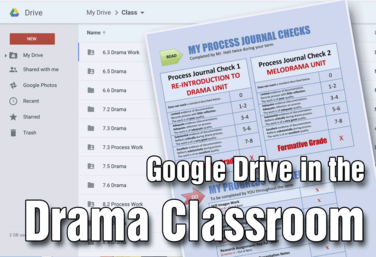
Instructor Joshua Hatt has taught drama students all over the world. He is passionate about the power of drama to connect people and the importance of reflection and journaling to build creative, critical thinkers.
He started using Google Drive as a response to the frustration of having his students lose curriculum booklets time and time again. His work developed into a powerful online home whereby students and teachers can communicate, contribute, collaborate, edit, and house all their documents online.
In this course, Josh will show you how to use Google Drive and Slides in your drama classroom. He's included step-by-step guided instruction, as well as activities to help you solidify your knowledge. Your drama classroom will be forever transformed!
Allison Williams leads the course: 21st Century Skills Through Devising. This course covers what devising is, why to do it, how to do it, and how your students can master the 21st Century Skills of collaborations and cooperation, critical thinking, creative thinking through devising.
High school is a great place to try devising with your students. But it’s not something you want to throw at your students without any preparation. Framework is important and this course takes you through a number of exercises you can take into the classroom tomorrow to help build a place of physical safety, a place where students work at making a lot of choices instead of waiting for the perfect choice, and a place where students feel comfortable making creative choices. The material also reviews the process of putting together a show from the idea/research stage to editing, to giving feedback.
Your students have what it takes to create their own material, collaborate with each other, and have a unique theatrical experience!
Directing youth theatre can be one of the most thrilling, rewarding, and exhausting jobs there is – because it’s not just about staging a play. It’s about creating an environment that fosters hard work, dedication, trust, and the willingness to take chances, to “play without fear.”
As a writer/teacher/director of youth theatre for over 15 years, I have developed tools and strategies that enable my students and me to focus on the process of creating theatre while fostering an environment that leads to creative freedom and a cohesive groups that doesn't act as individual “stars,” but as a community of one.
In this course, I will share with you these tips and strategies, along with the ways to implement them in your theatre environment.
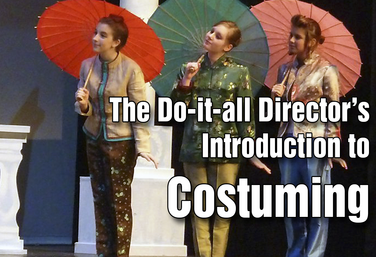
Do you know the difference between a bustle and a buckram frame? Or what works best as an emergency hem? Some directors are blessed with a big budget and a full support staff—a choreographer, a set designer, and a costumer. But the drama teacher often becomes director, choreographer, set designer, and costumer all in one.
And a budget? What’s a budget? The Do-It-All Director’s Introduction to Costuming will give you, the director, who must do it all, the confidence and skills to costume and direct, no matter your experience or budget. This course will teach you costuming basics, budget tricks, organization, and most importantly, the art of costuming as a director.
Holly Beardsley is a do-it-all director. She started directing middle and high school students in her early college years and since then has written over ten shows and directed twice as many.
Do-it-all directors are responsible for everything it seems – the direction, the costuming, the choreography and of course, the set too. And though directors are ready to direct, to costume and even dance, there is something intimidating about designing and building a set.
The Do-it-All Director’s Introduction to Set Design will give you the director, who must do-it-all, the confidence and skills to not only direct but build your own set as well - no matter your experience or budget. This course will teach you set design basics, construction tips, budget tricks, and how to tackle your precious performance space armed with a hammer, and most importantly, without fear.
In this course, James Van Leishout explores why students should direct, and covers the first two tools in the director’s toolbox: self and the script. What background should every director have? Why should they learn to love research? What should happen in the first four reads of a script?
With every step along the way, there will be exercises and activities your student directors can take on before they step into the rehearsal process.
Our parent company Theatrefolk offers a fantastic selection of plays written specifically for high school and middle school students.
Whether for performances or class study, there's something for everyone: relevant & relatable themes, simple sets & costumes, flexible casting options and much more - a perfect addition to any drama program!
Please note:
Plays are offered separately from your membership and can be purchased through Theatrefolk.