TH.68.C.2.4 Defend personal responses to a theatre production.
This page lists 30 units and 2 professional development courses aligned to TH.68.C.2.4 from the Florida Sunshine State Standards. Designed for drama teachers, these resources directly address TH.68.C.2.4 - Defend personal responses to a theatre production.
In this unit, students will learn, practice and apply three important rules of improv: accepting and building on offers, quick thinking, and strong offers. For each step, they will work with the Improvisation Rubric by both giving and receiving feedback. Students will also start to practice techniques to improve their vocal clarity. The unit culminates in a performance assessment in which students will play an improv game in front of an audience.
Students will understand the basic building blocks of a scene: The Who (characters/ relationship), the Where (setting), and the What (conflict – objectives/tactics). They will learn how to use both verbal and nonverbal (pantomime) clues to communicate these scene details to an audience. They will continue to work on voice clarity, while also learning to open their body to an audience. The unit culminates in a performance assessment in which students work in pairs to improvise a scene.
Students will be introduced to the most basic of scripts: the contentless/open scene script. They will use their knowledge of character/relationships, setting, objective, and tactics to add content to a contentless scene. Students will also learn the basics of set design and blocking, and will begin using voice expression to communicate clearer characters. The unit culminates in a performance assessment in which students will work in pairs to add content to and perform a contentless scene.
In this unit, students learn how to write their own scripts using correct formatting. These scripts will be more detailed than the contentless scenes. Students will learn how to write dialogue that provide information about relationships, conflicting objectives, and setting.
They’ll also learn how to correctly add expression and movement directions into the script itself. The unit will end with a partner script writing assignment which is performed in front of the class.
Students will now start applying the skills they’ve learned thus far in the context of existing, fleshed-out scripts.
They will also have opportunities to shift from actor to director and hone such skills as collaboration, self-confidence, and problem-solving which can be used in many other areas of their lives.
Students will have a chance to merge their understanding of scene elements with their improvisation skills in this final unit based on Augusto Boal’s Theatre of the Oppressed. Theatre of the Oppressed is a style of theatre specifically created to highlight the injustices of power and oppression in society and to problem-solve ways to bring about change.
Starting with image theatre techniques to identify issues of power and oppression, students will then use forum theatre to create scenarios of oppression taken from their own lives and improvise realistic solutions.
The unit culminates in a performance in which students participate as both actors in a scene they create themselves and spect-actors in scenes created by their peers.
This is an introductory mini-unit to lighting that can be achieved whether or not you have a lighting system. Students will work toward being able to demonstrate their knowledge of lighting effectiveness.
The questions of the unit include: How can light affect a scene? How can lighting affect the audience? What is the mood of the scene? How does lighting play a part in creating mood? How can you use shadows onstage? How does color impact the scene?
This is an introductory mini-unit to sound that you can use whether or not you have a sound system. Students will work toward being able to demonstrate their knowledge of sound effectiveness.
The questions of the unit include: What is effective sound? What sounds and music do we need in order to make our scene effective? How will we know our sound cues are effective?
If the costumes in a play are going to be effective, we need to be thoughtful about how we use them.
In this mini-unit, students will demonstrate their understanding costume effectiveness and address the following questions: What is the role of costume in the performance? How does color contribute? How does the style of costume affect a performance? How does costume indicate setting? Do you need costumes in a scene?
This is a mini-unit on staging. Along with the driving question for the unit, students will explore about how staging affects the performance. Students will draw a plot design (ground plan) to emphasize the need to plan where scenic elements will be placed. They will also practice taking cues from the script, in order to create staging.
This is a student centred mini-unit on makeup design. Makeup is useful in transporting an audience to a different world.
The purpose is for students to understand that makeup is a tool that theatre technicians can use in order to contribute to effective performance aesthetics; to understand basic makeup rules and care instruction; to understand how to complete a makeup design plot; to look at a project and figure out for themselves what they need to succeed.
Once students have completed the five Tech Theatre Units (Lighting, Sound, Costume, Staging, Free Play Makeup), you can give them this culminating project.
Depending on how you structured your technical theatre unit, you can adapt this project to suit your needs and context.
Up to this point, all the work in the units have been exploratory. This is where students will apply their skills and knowledge.
Join Matt Banaszynski in this dynamic unit designed to introduce students to the process of starting, drafting, polishing, and performing a self-created, stand-alone monologue.
This unit introduces students to writing their own stand-alone monologues. Students will learn the steps involved in going from a simple idea to a written piece to performing that piece. They will also provide feedback to others and give themselves a self-assessment.
This unit has been prepared for a middle school drama class but could be adapted for high school. It was designed as a way to get non-theatre students more involved in theatre.
Teacher Angel Borths developed this unit when she was looking for lessons to teach the basics of pantomime in the classroom.
This unit culminates in a finished product for performance, either for peers, or for theatre festivals. The rubrics and written work for this unit take planning and preparation for performance into account. The exercises can be pulled out and used independently, but work best when used to build toward a finished product. You can also pull the ground plan and stage directions lesson plans to use with playwriting or directing lessons.
This unit on Puppetry is designed for middle school and up, to introduce students to the material and get them comfortable with performing in a safe and low exposure environment.
This is a unit that builds to a culminating experience for your students. Each lesson is designed to explore techniques, provide opportunities for creative collaboration among your students, and give them opportunities to perform. Some of the lessons require materials to build or create puppets. Puppetry can be as easy as drawing a face on your finger for finger puppets, to actually purchasing your own finger puppets for students to use.
While the focus of this unit is puppetry, your students will explore other skills as well. There’s the obvious ones of creative thinking, teamwork, and problem solving. They are also going to explore storytelling, performing skills, and playwriting.
In studying Ancient Greece, we’re looking at the foundations of theatre as we know it today. Without the Ancient Greek Era, we do not get actors, theatres, plays, and the definitions of tragedy and comedy.
The issue with studying theatre history, or anything historical is that it can become an exercise in memorizing dates and reciting facts. When the truth of the matter is no one in the 21st century benefits from learning by rote. This is especially true when studying history in the framework of a drama classroom. We need exercises that bring history to life, instead of having students plot dates on a timeline.
To that end, this unit does not focus on dates and data. The essential question for the unit is how can we connect the past to the present and this question is explored through the theatricalization of information. Students will access all four 21st century skills, critical thinking, creative thinking, collaboration and communication as they explore this amazing world.
Reflections, exit slips, and rubrics are included throughout the unit as well as a mid assignment evaluation for the culminating project.
This unit focuses on character creation: How do you create a character from the ground up? Use this unit as a precursor to a playwriting unit, to a devising unit, or to a class production.
Using the archetypes of the superhero, the sidekick, and the supervillain, students work on exercises to help them create unique characters through physical and vocal qualities, character profiles, and theatrical writing.
Because many of the exercises have an individual focus, this unit works in a distance learning environment or for your no-technology students.
This Indigenous Storytelling unit is brought to you in a different format than a traditional lesson plan. It uses a learning circle format. It was developed by Allison Green, a member of the Algonquin Band of Mattawa Ontario, who is also the author and instructor of the DTA course Approaching Drama Class with an Indigenous Perspective.
Students will discuss origin stories, research the background and land connection of a variety of Indigenous creation stories, create a plot graph of their story, share with the class what they have learned, and then retell the story in their own words. Once students have practiced this process, they will repeat the steps with an Abenaki creation story: Research | Recreate | Understand.
Improv is a fantastic method to engage your students; this 3 lesson mini unit is a great way to introduce improvisation.
This unit focuses on learning the rules of Improv, trying games to build improvisation skills, and developing conflict and story line.Through the three lesson series, students will use journals, participate in class discussions, learn six different improv games, and perform for their peers.
Assessment tools include both informal assessment as well as a formal quiz that’s included in the unit.
Students will explore the question “What is theatre?” and contrast theatre to film. They will also begin their introduction to a couple of theatre roles.
When an audience watches a piece of theatre, they never see what goes on behind the scenes or know the people who work to make the production look its best. But theatre is a collaboration between what happens onstage and off.
This flipped learning unit will introduce students to the world of technical theatre. Through video, they will learn information on specific technical theatre roles and how they work together, types of stages, parts of a theatre and stage geography, and then apply this knowledge through in-class active-learning exercises.
For example, students will take on the role of a producer and decide how a budget will be divided among different departments. They will practice the calls a stage manager uses. The culminating assignment has students solve a common technical theatre issue: to design, create, and implement a solution for a unique stage direction in a play.
This unit provides an introduction to the process of playwriting in a practical step-by-step framework. Playwriting can be a practical task-driven process that any student can accomplish, given the right parameters. This playwriting unit will give students the tools they need to write their first short play and gain the confidence they need to write further. The culminating project for this unit is a three- to five-page play or extended scene.
Students are introduced to scene work performance through a simple, contentless scene unit. In this unit, performers will use exercises like “Show and Tell” to learn how to fill in the gaps of a story by creating scenarios and detailed characters with backgrounds.
Students will further fill in the gaps by exploring environmental and physical conflict as well as stage business. The lesson “Thou Shalts of Staging” will guide students through basic staging and performance technique.
In this unit, students will be introduced to a key element of performance: the voice. Students will explore how to thoughtfully communicate character, story, and emotion vocally. Students will begin by exploring articulation so that they understand the importance of clearly communicating their words onstage. They will further build on this with the following lesson on the different vocal varieties of pitch, tone, rate, and volume.
The final lesson helps students explore vocal characterization as well as the details and layers that can bring that character to life vocally. This unit study of the voice culminates in a final puppet show where students are asked to bring a story and character to life by using vocal variety, articulation, and characterization.
In this middle school unit by Rachel Atkins, students will explore how to strengthen a theatrical argument through objectives, communication, and conflict: What characters do, what they say, and how they say it when they make an argument or try to achieve an objective. To do this, students will use tableaux, dialogue, and improv. There are presentations and post-lesson writing assignments that you can use for assessment.
How do characters, actors and writers use a variety of actions to achieve an objective or support an argument? How do they enhance their communication by word choice and emotion? How do they develop and strengthen their own arguments by understanding other points of view?
A monologue unit is an excellent way for students to demonstrate learned skills: vocal skills, movement skills, memorization skills, and character development. It also touches on soft skills such as communication, confidence, and attitude. That being said, monologues are not easy. A typical monologue is two minutes long. That is a lot of text to memorize, block, and develop into an engaging presentation. How often have you sat through a bad monologue performance with little to no characterization, wandering blocking, and a tenuous grasp of the lines?
Performing a monologue is a learned skill. And the best way to learn a skill is in steps. Instead of starting with the end goal—that two-minute piece—start at the beginning. This four-lesson unit will take students up the ladder toward the goal of a longer monologue.
This Technical Theatre unit is designed to empower student leaders to analyze management roles in producing theatre while also using collaborative activities and reflection exercises to strengthen soft skills that every student should have. The unit covers the roles of producer, director, technical director, and stage manager, and ends in a culminating project.
Auditioning is a skill. It takes a lot of work to prepare to audition for a role. When students audition for a musical, there are even more skills needed as you will have to sing and dance.
In this unit, students will explore the specifics of musical theatre audition technique (such as creating a musical theatre portfolio) and participate in a mock audition where students will prepare 16 or 32 bars of a song and perform a dance step in the style of a specific character.
Screenplays 101 is divided into two separate units: Basic Structure and Basic Formatting.
It is highly recommended that you complete the Basic Structure unit before moving on to the Basic Formatting unit.
In this unit, we will focus on a basic history of screenplays, screenplay terminology, and the most common screenplay structure in film—the three-act structure. Theatre is important because it allows our young artists to be trained and learn about work ethic and discipline, and it creates community. But, we should also give our students opportunity and access to the cinematic arts. This is primarily a lecture-based unit with a lot of new information, with opportunities for students to apply knowledge including a final culminating project.
In the 21st century, we are living in a time of great change for criticism and the role of the critic. Previously, one negative review from the New York Times could close a Broadway show. Now the audience as critic is a topic of much debate. Are professional critics and informed opinions necessary? What is the power of the audience critic? What is the role of the critic and the role of criticism in today’s theatre?
This unit will take students through a brief history of the theatre critic from the 500 reviews that came out of Ibsen’s one-night performance of Ghosts in 1891, to the tumultuous landscape of social media criticism. Students will then apply what they’ve learned by writing on or theatricalizing the role of the critic in a culminating assignment.
Instructor Joshua Hatt has taught drama students all over the world. He is passionate about the power of drama to connect people and the importance of reflection and journaling to build creative, critical thinkers.
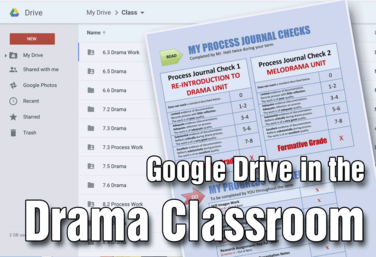
He started using Google Drive as a response to the frustration of having his students lose curriculum booklets time and time again. His work developed into a powerful online home whereby students and teachers can communicate, contribute, collaborate, edit, and house all their documents online.
In this course, Josh will show you how to use Google Drive and Slides in your drama classroom. He's included step-by-step guided instruction, as well as activities to help you solidify your knowledge. Your drama classroom will be forever transformed!
Screenwriter Nick Pappas leads a two-part course on screenplays 101. Great scriptwriting is not something that can be covered in a single course: so we're going to start with the basics. Those basics are going to be split up into a Part 1 and a Part 2. Part 1, this course, will concentrate on basic film structure. Part 2 will concentrate on screenplay formatting.
By the end of this course, students should have a basic understanding of history, terminology, and are able to identify the barest bones of the three-act structure, all with an eye toward developing their own screenplay.
Our parent company Theatrefolk offers a fantastic selection of plays written specifically for high school and middle school students.
Whether for performances or class study, there's something for everyone: relevant & relatable themes, simple sets & costumes, flexible casting options and much more - a perfect addition to any drama program!
Please note:
Plays are offered separately from your membership and can be purchased through Theatrefolk.