7.PR.2.2 Compare the expectations of an audience in different venues.
This page lists 12 units and 6 professional development courses aligned to 7.PR.2.2 from the North Carolina Essential Standards 2024. Designed for drama teachers, these resources directly address 7.PR.2.2 - Compare the expectations of an audience in different venues.
Students will be introduced to the most basic of scripts: the contentless/open scene script. They will use their knowledge of character/relationships, setting, objective, and tactics to add content to a contentless scene. Students will also learn the basics of set design and blocking, and will begin using voice expression to communicate clearer characters. The unit culminates in a performance assessment in which students will work in pairs to add content to and perform a contentless scene.
In this unit, students learn how to write their own scripts using correct formatting. These scripts will be more detailed than the contentless scenes. Students will learn how to write dialogue that provide information about relationships, conflicting objectives, and setting.
They’ll also learn how to correctly add expression and movement directions into the script itself. The unit will end with a partner script writing assignment which is performed in front of the class.
Students will now start applying the skills they’ve learned thus far in the context of existing, fleshed-out scripts.
They will also have opportunities to shift from actor to director and hone such skills as collaboration, self-confidence, and problem-solving which can be used in many other areas of their lives.
Students will have another opportunity to participate in student-directed scenes, only this time each director will be assigned a different script, and actors for each group will be chosen by the teacher based on individual strengths and challenges, rather than holding auditions.
Actors will take a deeper dive into character physicality and use of levels in staging this unit. Directors will continue to create a set design and block the scenes, adding props as well in this unit.
The unit culminates in actors presenting their directed scenes to the class.
Students will have a chance to merge their understanding of scene elements with their improvisation skills in this final unit based on Augusto Boal’s Theatre of the Oppressed. Theatre of the Oppressed is a style of theatre specifically created to highlight the injustices of power and oppression in society and to problem-solve ways to bring about change.
Starting with image theatre techniques to identify issues of power and oppression, students will then use forum theatre to create scenarios of oppression taken from their own lives and improvise realistic solutions.
The unit culminates in a performance in which students participate as both actors in a scene they create themselves and spect-actors in scenes created by their peers.
This unit looks at theatre jobs in the business category: front of house, marketing, and box office. The aim of these jobs is to interact with the public. Students are able to identify what “front of house” refers to and understand the various roles of a theatre company’s front of house members.
Students will also explore how a show is marketed and demonstrate their knowledge of marketing by creating a simple marketing campaign for an original show.
The purpose of this unit is to give students an introduction to independent learning as well as an overview of Ancient Greek theatre. Students will apply their knowledge throughout, and the unit culminates in a group activity.
This unit is delivered in hyperdoc format. What does that mean? A hyperdoc is an interactive tool that encourages digital learning. In this case, students are given a document on a subject, and there they can read articles, watch videos, do some independent research, and apply what they’ve learned. Because they’re working on their own, students are in charge of their own pacing.
Before you start the unit, ensure you read the Teacher Guide first. It will give you clear instructions on how to distribute the hyperdoc format and make it easy for you and your students.
In the 21st century, we are living in a time of great change for criticism and the role of the critic. Previously, one negative review from the New York Times could close a Broadway show. Now the audience as critic is a topic of much debate. Are professional critics and informed opinions necessary? What is the power of the audience critic? What is the role of the critic and the role of criticism in today’s theatre?
This unit will take students through a brief history of the theatre critic from the 500 reviews that came out of Ibsen’s one-night performance of Ghosts in 1891, to the tumultuous landscape of social media criticism. Students will then apply what they’ve learned by writing on or theatricalizing the role of the critic in a culminating assignment.
This unit gives students an overview of the anti-realism movement of the late 19th century and early 20th century and introduces them to some key theorists, playwrights, and theatre makers involved in this movement. Students will be introduced to the “isms” of symbolism, Dadaism, surrealism, expressionism, and absurdism along with various manifestos and theories as we track the characteristics of each “ism.”
In a culminating project, students will design an “ISMS’’ Theme Park, which they will share with the class at the end of the unit. Their project will feature each of the five “isms” in the form of rides, themed concessions areas, entertainment options, and in-park characters.
In this unit, students will learn about Antonin Artaud and how his ideas influenced avant-garde theatre in the 20th and 21st centuries. They will also learn how Jerzy Grotowski took Artaud’s theories into new directions. This is done through direct instruction. A culminating presentation will ask students to take common stories and reimagine them using some of these ideas. They will present a “pitch” of an avant-garde version of their story. In the second lesson, students learn about some of the ideas of Augusto Boal and try a session of Forum Theatre.
Screenplays 101 is divided into two separate units: Basic Structure and Basic Formatting.
**It is highly recommended that you complete the Basic Structure unit before moving on to the Basic Formatting unit.**
In this unit, we will focus on a basic history of screenplays, screenplay terminology, and the most common screenplay structure in film—the three-act structure. Theatre is important because it allows our young artists to be trained and learn about work ethic and discipline, and it creates community. But, we should also give our students opportunity and access to the cinematic arts. This is primarily a lecture-based unit with a lot of new information, with opportunities for students to apply knowledge including a final culminating project.
Adaptation is a fabulous classroom project: it requires students to analyze, adapt, modify, plan, synthesize, and devise. However, it takes skill to write a successful adaptation; you can’t just throw a narrator into a script and consider the work done. In this unit, students will go through a step by step pre-writing process in order to prepare them to write their own adaptations. They will learn and practice the elements of adaptation before writing the first draft of their own theatrical adaptations.
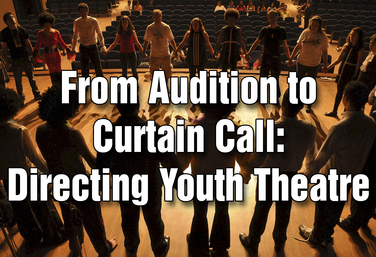
Directing youth theatre can be one of the most thrilling, rewarding, and exhausting jobs there is – because it’s not just about staging a play. It’s about creating an environment that fosters hard work, dedication, trust, and the willingness to take chances, to “play without fear.”
As a writer/teacher/director of youth theatre for over 15 years, I have developed tools and strategies that enable my students and me to focus on the process of creating theatre while fostering an environment that leads to creative freedom and a cohesive groups that doesn't act as individual “stars,” but as a community of one.
In this course, I will share with you these tips and strategies, along with the ways to implement them in your theatre environment.
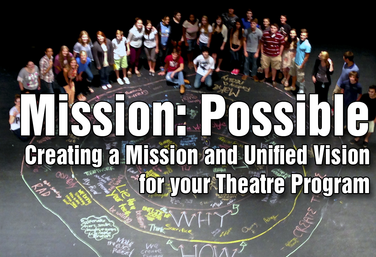
Whether you're in a new school or have an existing program, you can use a Mission Statement to define your program, unify your students and let everyone know from administration, to parents, to the community why you do theatre, what you do and how you do it. Learn how to create this powerful and vital statement with your students. Mission Possible takes you through step by step from asking the right questions, to looking at your school culture and traditions, to writing and revising, to shouting your statement from the rooftops.
This course covers the four stages of creating and implementing a marketing plan. It starts with the question, what are you selling?, and goes all the way through to evaluation. The course covers both traditional and new media, with examples and opportunities to apply the learning to each teacher's own situation.
Adaptation is a fabulous classroom project: it requires students to analyze, adapt, modify, plan synthesize, devise. All the higher order thinking skills.
But you can’t just throw a narrator into a script and call it a day. You have to have a preparation process leading up to the writing process.
In this course you will learn practical exercises and a path to prepare your students to take on their own adaptation project. We’ll look at the guidelines to adaptation, things to think about when choosing a text, how to analyze the source material and writing that first draft.
So join me, Lindsay Price, in the Play Adaptation Project.
This course is a mix of individual and group activities requiring students to use both their analytical and creative mind. It gives students an overview on the Anti-Realism movement of the late-19th and early-20th century, and introduces them to some key theorists, playwrights, and theater makers involved in this movement.
Together we will guide students through the wild world of the “isms,” more specifically Symbolism, Dadaism, Surrealism, Expressionism and Absurdism. We will introduce students to various manifestos and theories as we track the characteristics of each of our five “isms.” As we combine analysis and creative exercises, students bring their entire self to process and prepare to design an ISM Theme Park project, which they will share with the class at the end of the course.
Screenwriter Nick Pappas leads a two-part course on screenplays 101. Great scriptwriting is not something that can be covered in a single course: so we're going to start with the basics. Those basics are going to be split up into a Part 1 and a Part 2. Part 1, this course, will concentrate on basic film structure. Part 2 will concentrate on screenplay formatting.
By the end of this course, students should have a basic understanding of history, terminology, and are able to identify the barest bones of the three-act structure, all with an eye toward developing their own screenplay.
Our parent company Theatrefolk offers a fantastic selection of plays written specifically for high school and middle school students.
Whether for performances or class study, there's something for everyone: relevant & relatable themes, simple sets & costumes, flexible casting options and much more - a perfect addition to any drama program!
Please note:
Plays are offered separately from your membership and can be purchased through Theatrefolk.