
Alberta, Canada
Senior Goal III Objectives
12 units • 6 professional development courses aligned to
develop an awareness of aesthetics in visual and performing arts
View all Standards for Alberta, Canada
develop an awareness of aesthetics in visual and performing arts
This page lists 12 units and 6 professional development courses aligned to from the Alberta, Canada. Designed for drama teachers, these resources directly address develop an awareness of aesthetics in visual and performing arts
UNIT
Voice
by Anna Porter
3 lessons
In this unit, students will be introduced to a key element of performance: the voice. Students will explore how to thoughtfully communicate character, story, and emotion vocally. Students will begin by exploring articulation so that they understand the importance of clearly communicating their words onstage. They will further build on this with the following lesson on the different vocal varieties of pitch, tone, rate, and volume.
The final lesson helps students explore vocal characterization as well as the details and layers that can bring that character to life vocally. This unit study of the voice culminates in a final puppet show where students are asked to bring a story and character to life by using vocal variety, articulation, and characterization.
UNIT
Puppetry
by Jenny Goodfellow
9 lessons
This unit on Puppetry is designed for middle school and up, to introduce students to the material and get them comfortable with performing in a safe and low exposure environment.
This is a unit that builds to a culminating experience for your students. Each lesson is designed to explore techniques, provide opportunities for creative collaboration among your students, and give them opportunities to perform. Some of the lessons require materials to build or create puppets. Puppetry can be as easy as drawing a face on your finger for finger puppets, to actually purchasing your own finger puppets for students to use.
While the focus of this unit is puppetry, your students will explore other skills as well. There’s the obvious ones of creative thinking, teamwork, and problem solving. They are also going to explore storytelling, performing skills, and playwriting.
Unit
6
of
7
in
Drama Two
Curriculum
UNIT
Design
by Matt Webster
6 lessons
In this unit, students will explore and experiment with the basic building blocks of design: Line, Shape, and Color. Once students have a solid foundation of those concepts, they will move on to stage properties and scenic flats as additional building blocks of design. They will then apply their knowledge and skills to a series of assignments, so they can demonstrate their design knowledge and creativity.
Unit
2
of
6
in
Technical Theatre Mini Units
Curriculum
UNIT
Sound
by Josh Hatt
5 lessons
This is an introductory mini-unit to sound that you can use whether or not you have a sound system. Students will work toward being able to demonstrate their knowledge of sound effectiveness.
The questions of the unit include: What is effective sound? What sounds and music do we need in order to make our scene effective? How will we know our sound cues are effective?
Unit
3
of
6
in
Technical Theatre Mini Units
Curriculum
UNIT
Costuming
by Josh Hatt
5 lessons
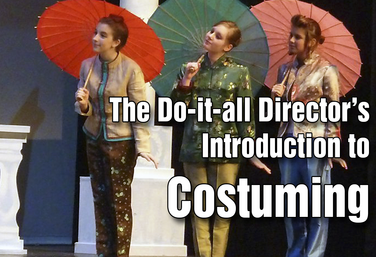
If the costumes in a play are going to be effective, we need to be thoughtful about how we use them.
In this mini-unit, students will demonstrate their understanding costume effectiveness and address the following questions: What is the role of costume in the performance? How does color contribute? How does the style of costume affect a performance? How does costume indicate setting? Do you need costumes in a scene?
Unit
4
of
6
in
Technical Theatre Mini Units
Curriculum
UNIT
Staging
by Josh Hatt
5 lessons
This is a mini-unit on staging. Along with the driving question for the unit, students will explore about how staging affects the performance. Students will draw a plot design (ground plan) to emphasize the need to plan where scenic elements will be placed. They will also practice taking cues from the script, in order to create staging.
Unit
5
of
6
in
Technical Theatre Mini Units
Curriculum
UNIT
Free Play Makeup
by Josh Hatt
8 lessons
This is a student centred mini-unit on makeup design. Makeup is useful in transporting an audience to a different world.
The purpose is for students to understand that makeup is a tool that theatre technicians can use in order to contribute to effective performance aesthetics; to understand basic makeup rules and care instruction; to understand how to complete a makeup design plot; to look at a project and figure out for themselves what they need to succeed.
Unit
6
of
6
in
Technical Theatre Mini Units
Curriculum
UNIT
Culminating Project
by Josh Hatt
Once students have completed the five Tech Theatre Units (Lighting, Sound, Costume, Staging, Free Play Makeup), you can give them this culminating project.
Depending on how you structured your technical theatre unit, you can adapt this project to suit your needs and context.
Up to this point, all the work in the units have been exploratory. This is where students will apply their skills and knowledge.
UNIT
Introduction to Film Analysis: Mise en scène
by Lindsay Price
7 lessons
Lindsay Price has developed this Introduction to Film Analysis Unit: Mise en scène. In order to develop visual literacy, students have to be able to analyze what they see. In a film, the composition of everything you see on screen is called mise-en-scène. In this unit, students will explore the individual elements that make up mise-en-scène, be able to identify those elements in stills and film scenes, and apply their knowledge in a culminating analysis activity.
Heads up. You’re going to need some technology for this unit. Students need to be able to view, either as a class or 1:1 images, a google slide deck and selected film scenes.
Unit
3
of
13
in
Stagecraft Without a Theatre
Curriculum
UNIT
Scenic Design
by Karen Loftus
6 lessons
Students will explore the creation of an environment through the art of scenic design. They will identify what scenic design is and how it helps to tell a story in theatre. Students will also identify and demonstrate some skills of a scenic designer as they analyze an excerpt of a script for scenic clues and demonstrate basic drafting and rendering.
Unit
11
of
13
in
Stagecraft Without a Theatre
Curriculum
UNIT
Make-Up Design
by Karen Loftus and Josh Hatt
1 lesson
Students will be able to explore the use of make-up as a theatrical tool and demonstrate their knowledge of make-up effectiveness.
UNIT
Tech Theatre Unit: Costuming When You Don't Sew
by Drama Teacher Academy
8 lessons
In this unit, students will take on the role of the costumer, which is different from a costume designer. It introduces costuming concepts in order to execute a costume. No complicated sewing is required, which is great if you don’t have the background, the access, or the resources to have a class of students create costumes.
Instead of making costumes from scratch, as a designer would, students will create costumes from stock, borrowed items, or low-cost finds. They will take finished products and adapt them into what they need to create the right atmosphere.
In order to help with their adaptations, students will try different distressing techniques and learn three SIMPLE stitches that they’ll be able to use over and over again. It’s a valuable tech theatre skill to teach students how to execute on costumes when you (and they) don’t sew!
View all Standards for Alberta, Canada Standards Master List