Common Core
Language
11 units • 11 professional development courses aligned to
CCSS.ELA-LITERACY.L.9-10.5 - Demonstrate understanding of figurative language, word relationships, and nuances in word meanings.
View all Standards for Common Core
CCSS.ELA-LITERACY.L.9-10.5 Demonstrate understanding of figurative language, word relationships, and nuances in word meanings.
This page lists 11 units and 11 professional development courses aligned to CCSS.ELA-LITERACY.L.9-10.5 from the Common Core. Designed for drama teachers, these resources directly address CCSS.ELA-LITERACY.L.9-10.5 - Demonstrate understanding of figurative language, word relationships, and nuances in word meanings.
Unit
9
of
14
in
Drama One
Curriculum
UNIT
Elizabethan Theatre
by Karen Loftus
6 lessons
How do you introduce students to Shakespeare? This unit introduces the Bard through life in Elizabethan England and the playwrights, players, and playhouses. It also explores how to approach unfamiliar words and context clues in Shakespeare’s texts.
Unit
14
of
14
in
Drama One
Curriculum
UNIT
Drama One Final Project
by Karen Loftus
5 lessons
The final project will incorporate multiple areas that students have studied over the course of the year/semester: playwriting, acting, scenic design, and marketing. They are putting everything they’ve learned into a final package, including writing, rehearsing, and performing.
UNIT
Puppetry
by Jenny Goodfellow
9 lessons
This unit on Puppetry is designed for middle school and up, to introduce students to the material and get them comfortable with performing in a safe and low exposure environment.
This is a unit that builds to a culminating experience for your students. Each lesson is designed to explore techniques, provide opportunities for creative collaboration among your students, and give them opportunities to perform. Some of the lessons require materials to build or create puppets. Puppetry can be as easy as drawing a face on your finger for finger puppets, to actually purchasing your own finger puppets for students to use.
While the focus of this unit is puppetry, your students will explore other skills as well. There’s the obvious ones of creative thinking, teamwork, and problem solving. They are also going to explore storytelling, performing skills, and playwriting.
UNIT
Shakespeare Performance
by Anna Porter
11 lessons
In this unit by Anna Porter, students are introduced to the works of Shakespeare and explore how to bring a character to life in a monologue performance. Students are also introduced to the tools to help them unlock meaning in Shakespeare’s text. Through this eleven lesson series, students will participate in class discussions, activities and performance. Assessment tools include informal assessment, submission of textual analysis work and a final performance.
UNIT
Unlocking Shakespeare's Text
by Anna Porter
5 lessons
Shakespeare’s text holds valuable tools that students can use to unlock and understand meaning. In this unit by Anna Porter, students explore how to use the tools of research, context, textual analysis, imagery and punctuation to help them unlock meaning in Shakespeare’s text. This unit is created for an Intermediate to Advanced drama class with a basic background in plot structure and acting technique.
Through this five lesson series, students will use journals, participate in class discussions, activities and performance to explore the tools used to unlock a text. Assessment tools include informal assessment as well as a final group presentation and performance.
UNIT
Our Town Unit
by Lindsay Price
8 lessons
This is a read, discuss, and apply literature unit. Students will study the play Our Town by Thornton Wilder.
Our Town is often referred to as “nostalgic.” It’s seen as an antiquated look at a moment in time. But this play is called Our Town, not My Town. What’s happening in Grover’s Corners happened in the past, the distant past, in our present, and even in the future. The themes of the play—the ordinary versus universality, the concept of time, the cycle of life, the ignorance of humanity to the eternal—these are just as relevant in the twenty-first century as they were when the play was written.
The purpose of the unit is not to have students recall knowledge about the play. Students will be able to identify, articulate, and dramatize text themes and concepts and compare/contrast these concepts to their own experiences.
UNIT
Scene Staging
by Lindsay Price
15 lessons
The goal for this unit is to give students a process to work primarily on their own to create a staged scene with specific, dynamic blocking and three-dimensional characters. This unit would work well as a culminating project for a semester. In this unit, students will work independently to analyze, block, build character, experiment, and rehearse a scene. Their performance can count as a summative assessment for the class.
Material: This unit requires that students have access to scenes from plays. Ideally, students should work in pairs and prepare duet scenes.
UNIT
Spoken Word Poetry
by Quincy Young
4 lessons
In this unit, students will create a performance of a spoken word poem designed to engage, entertain, and affect an audience. They will also write a poet’s statement in which they describe the purpose(s) or inspiration(s) of their poetry.
This is not a technical writing unit and is geared more toward students self-expression and engaging an audience. If your students are not skilled poets, this unit is still accessible.
UNIT
The Crucible Unit
by Lindsay Price
8 lessons
This is a research, read, discuss, and apply theatrical literature unit. Students will study the play The Crucible by Arthur Miller.
The Crucible is Miller’s most produced play. There are hundreds of high school productions each year, and the play is in many high school curricula. As with every Miller work, there is much to discuss and many rich themes to explore.
The unit is divided into three sections. Each section is a complete set of lessons. You can choose to do all three sections, or if you have your own way to teach the play, you can pick and choose exercises.
UNIT
A Midsummer Night's Dream
by Drama Teacher Academy
9 lessons
Shakespeare is sometimes avoided in the drama classroom because not only do the students not want to take on the language difficulties but neither do the teachers. Monologue and scenework becomes more challenging and a lot of times, students falter in their blocking action and character development because they are so challenged. How do we give students the opportunity to rehearse and present Shakespearean text as they would modern text?
In this play study unit, students will read a Shakespeare play while learning specific tools and techniques in order to stage text from that play. And more often than not, these techniques are ones that they have already used with other plays. It’s all about reframing Shakespeare so that students enjoy the experience of bringing the characters and stories to life.
UNIT
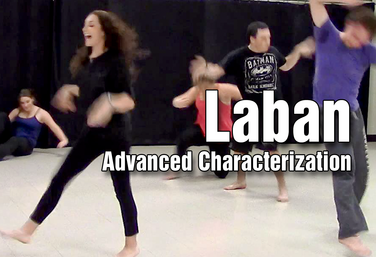
Laban: Advanced Characterization
by Drama Teacher Academy
7 lessons
This is an advanced acting unit in playing character through the Laban movement technique. Students will explore dance theorist Rudolf Laban’s eight efforts and their component parts; turn these elements into physicalizations through which one can express character; use Laban efforts and connect them to a character’s voice and body; and demonstrate knowledge through the creation of an original character.
Reminder: This is an advanced acting unit. You will need students who can do work on their own outside of class time, commit to movement and sound, and commit to making instinctual choices.
.png)