Facebook Pixel Skip to main content

Alberta, Canada
Orientation Drama 10

19 units • 15 professional development courses aligned to
demonstrate trust by becoming comfortable with others, physically and emotionally

View all Standards for Alberta, Canada

demonstrate trust by becoming comfortable with others, physically and emotionally

This page lists 19 units and 15 professional development courses aligned to from the Alberta, Canada. Designed for drama teachers, these resources directly address demonstrate trust by becoming comfortable with others, physically and emotionally

What is Theatre?

by Karen Loftus

Students will explore the question “What is theatre?” and contrast theatre to film. They will also begin their introduction to a couple of theatre roles.

Stage Movement

by Karen Loftus

Students will get “onstage.” They will explore what is important for onstage action, the basics of stage directions, and how to keep open. This unit will culminate with students trying out what they’ve learned in a short scene. This unit is more about the technicalities of moving on stage. By giving students something concrete to focus on, it allows them to overcome any stage fright. Ensemble-building exercises are also included in this unit. If you have time at the end of a lesson after you’ve completed your instruction and are wondering what to do, you can never go wrong with an ensemble-building exercise!

Ancient Greek Theatre

by Karen Loftus

This unit on Ancient Greek theatre focuses on the function of the chorus, the choral ode, and the details of the theatre space. It touches on plays and playwrights of the era, culminating in a final project of a modern version of Medea that includes a choral ode.

Improvisation

by Karen Loftus

Students sharpen their listening and reaction skills through improv games, exercises, and scenes. They will learn five specific guidelines to apply to their improvisation: accept the offer, bring information to the scene, make active choices, make your partner look good, and don’t force the humour. There are so many different ways to approach a unit on improvisation. Keep in mind that you will have students who are really excited about this unit and some students who dread it. It’s best to start with low-risk games and exercises and then build up to higher-risk ones. Low-risk games in this situation mean partnered interactions that aren’t shared with the whole class.

Commedia Dell'Arte

by Karen Loftus

Students will discover, analyze, and explore the history, characters, and style of commedia dell’arte. Commedia dell’arte is a theatre history unit mixed with improvisation, physicalization, and exploring specific characters. In this unit, we’re going to focus on three main aspects: 1. Causes and Effects of Commedia (History) 2. Stock Characters 3. Commedia Performance Practices

Commedia dell'Arte

by Todd Espeland

Commedia dell’arte is a 16th century masked acting form. It is the basis of all comedy, including all tv sitcoms. This form is characterized by masked types and archetypical characters and a specific way of playing comedy. To that end, this unit is divided into two parts. Part One focuses on the foundations of commedia - playing comedy. These principles will be important to learn when it comes to developing commedia characters, specifically the physicality of the characters. Part Two will cover lazzi. Note: there are links to video demos in many of the lessons of this unit.

Production Classroom Units Overview

by Karen Loftus

The overview lays out the all of the parts of The Production Classroom Units - which is divided into three parts. In Part One, you’ll take your students through a series of pre-production units designed to help students gain as much comprehension as possible about putting on a successful production. Part Two offers articles on each step in the process, samples and forms, a suggested pacing, role definitions and task checklists, an outline for a typical class, as well as performance duties. This section also outlines the assessment piece for The Production Classroom – the production binder. Part Three provides a Post-Performance Reflection. Unpack the experience with students, reflect back on what went right and what could be changed for next time. A written Reflection is included as well as a Rubric for student production binders.

Part One - Pre-Production

by Karen Loftus

In Part One of The Production Classroom, you’ll take your students through a series of pre-production units designed to help students gain as much comprehension as possible about putting on a successful production.

Part Two - Rehearsal and Performance

by Karen Loftus

Part Two offers articles on each step in the process, samples and forms, a suggested pacing, role definitions and task checklists, an outline for a typical class, as well as performance duties. This section also outlines the assessment piece for The Production Classroom – the production binder.

Part Two - Documents

by Karen Loftus

This section provides samples and worksheets for actor forms, costume department, general binder, lighting and sound, marketing samples, scenic and prop samples, and stage management and production manager samples and forms.

Part Three - Reflection and Assessment

by Karen Loftus

Part Three provides a Post-Performance Reflection. Unpack the experience with students, reflect back on what went right and what could be changed for next time. A written Reflection is included as well as a Rubric for student production binders.

Unit One: Ensemble Building and Class Norms

by Lindsay Johnson

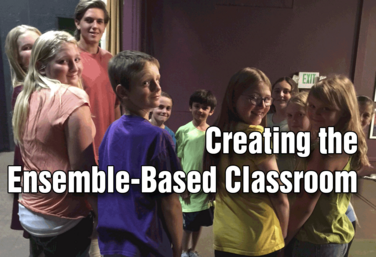
This unit has six lessons that you can use in the first week of your middle school program. What do you do in the first week? The most important elements are creating routines such as journal prompts, opening and closing circles, and giving strong feedback; creating an ensemble and ensemble-building games; and introducing a Weekly Ensemble Rubric. Students will define and build ensemble as a group, learning specific ways they can SAY YES and BE SAFE in class. They will understand the daily grading system and the basic routines of class. Finally, students will learn to give strong feedback by connecting specific evidence from performance to the Rubric language.

Unit Three: Building Improvised Scenes

by Lindsay Johnson

Students will understand the basic building blocks of a scene: The Who (characters/ relationship), the Where (setting), and the What (conflict – objectives/tactics). They will learn how to use both verbal and nonverbal (pantomime) clues to communicate these scene details to an audience. They will continue to work on voice clarity, while also learning to open their body to an audience. The unit culminates in a performance assessment in which students work in pairs to improvise a scene.

What is Theatre?

by Lindsay Price and Karen Loftus

Students will establish a definition of theatre, know the difference between theatre and film, and start to explore who’s who in the theatre.

Improvisation

by Lindsay Price and Karen Loftus

Students sharpen their listening and reaction skills through improv games, exercises, and scenes. They will learn five specific guidelines to apply to their improvisation: accept the offer, bring information to the scene, make active choices, make your partner look good, and don’t force the humor.

Impowerment Improv

by Jennine Profeta

Taking risks, learning to see failure as a gift, finding courage when we don't feel it, and having the awareness that what we say has an impact are social and emotional skills students will take beyond the classroom. These are skills that can be built through improv exercises. The exercises in this unit are designed to create a safe environment in which students can go beyond their old patterns to take risks, embrace failure, and be more confident and aware of the effects of their word choices. Improv gives you the opportunity to draw attention to these important concepts and to talk about them.

The Dilemma Project

by Claire Broome

The Dilemma Project is based on a situation that requires a decision: push a button and get a great reward, but there’s also a great consequence. Don’t push the button and there’s no reward. This unit will lead to a group performance including characters, costumes, set, acting theory, acting tools, and a student written script. The final script will be about ten pages in length which means roughly ten minutes of stage time.

Introduction to Stanislavski

by Drama Teacher Academy
This is an in-depth unit with instruction and activities about the Stanislavski acting method. It is followed by scene work in which students learn how to score a scene, do a comprehensive character analysis, and use what they have learned in rehearsals in a performance. Students will also watch their own work and evaluate their process after the performance. The purpose of this unit is to give students an introduction and understanding of Stanislavski’s method and to put it into use as they prepare scenes for performance. After seeing their work, and spending time reflecting on how they used the principles of the method, students should take away a concrete understanding of how to prepare a role for performance.

Virtual Introduction to Stanislavski

by Drama Teacher Academy
The unit has been adapted for a virtual environment. This is an in-depth unit with instruction and activities about the Stanislavski acting method. It is followed by scene work in which students learn how to score a scene, do a comprehensive character analysis, and use what they have learned in rehearsals in a performance. Students will also watch their own work and evaluate their process after the performance. The purpose of this unit is to give students an introduction and understanding of Stanislavski’s method and to put it into use as they prepare scenes for performance. After seeing their work, and spending time reflecting on how they used the principles of the method, students should take away a concrete understanding of how to prepare a role for performance.

View all Standards for Alberta, Canada    Standards Master List