
Texas Essential Knowledge and Skills for Theatre Arts
HS 117.316 LII - Foundations: Inquiry and Understanding
36 units • 6 professional development courses aligned to
C.1.C - demonstrate effective voice and diction.
View all Standards for Texas Essential Knowledge and Skills for Theatre Arts
C.1.C demonstrate effective voice and diction.
This page lists 36 units and 6 professional development courses aligned to C.1.C from the Texas Essential Knowledge and Skills for Theatre Arts. Designed for drama teachers, these resources directly address C.1.C - demonstrate effective voice and diction.

PD COURSE
Friendly Shakespeare
by Todd Espeland
9 modules
2 hours, 5 minutes
4 Credit Hours
Friendly Shakespeare teaches a simple and effective method of script analysis for Shakespeare. It uses punctuation and keywords in the text to help students understand the characters' needs, make specific acting choices, and get them on their feet immediately.
This is not dry, sitting in a classroom discussion. It’s physicalizing the text, focusing on the character’s needs and tactics (something every drama student should know full well) and bringing Shakespeare to life.
At the end of the class you will be able to demystify Shakespeare's text and understand how to help your actors make clear, active and emotionally connected choices in Shakespeare's plays.
PD COURSE
The Production Classroom
by Karen Loftus
8 modules
1 hours, 46 minutes
4 Credit Hours
In The Production Classroom, instructor Karen Loftus will show you how to explore ways that you can produce shows during your regular class time. The course gives you a series of exercises and reflections that help you determine everything, from the type of show you may want to do, to the way you can divide up your class and responsibilities, to specific assignments that will keep your students engaged and focused.
The Production Classroom is the ultimate in project-based learning. Students learn to work collaboratively while setting goals and working towards a successful finished project. The course includes exercises and strategies to use with students to help assure their success in the production. Multiple examples and anecdotes help you to envision what the production classroom could look like in your room, performance space or theatre.
PD COURSE
Teaching Musical Theatre in the Drama Classroom
by Colin Oliver
7 modules
1 hours, 51 minutes
4 Credit Hours
Colin Oliver leads this introduction to teaching Musical Theatre in the Drama Classroom.
In this course, you will learn how to build musical theatre into your dramatic courses of study. “Why might you want to do that? Singing is scary! You want me to teach my students how to do it? I don’t even know how to do it.” This course approaches musical theatre preparation performance much as we would approach preparing a monologue in drama. If you use script analysis in monologue preparation in your class, you can teach musical theatre.
By the end of this course, you’ll have a great, full-body physical warm-up, a student-driven research assignment, character development exercises, a little bit of musical theory, and a performance assignment complete with assessment.
So, join us for teaching Musical Theatre in the Drama Classroom. It’s as easy as Do-Re-Mi!
PD COURSE
The Process of Creativity in the Theatre Classroom
by Gai Jones
6 modules
2 hours, 38 minutes
5 Credit Hours
Gai Jones leads this course in establishing an environment of creative experimentation in the theatre classroom, in order to have a group of student actors who value the creative process.
Each lesson shares experiences to foster creativity without the stress of performance by student actors. For the creative process which honors out-of-the-box thinking, there is no assessment section included. There is no product or performance. The important thing is the student actor’s engagement. Their reflections and your observations are valued for positive learning.
This set of lessons includes Tips for the Theatre Educator, based on Gai's own Theatre practice. Scripts are also provided and contain text of what you can say to your students to facilitate their creative processes.
PD COURSE
Practical Approaches to Shakespeare in the Drama Classroom
by Julie Hartley
19 modules
3 hours, 9 minutes
5 Credit Hours
Shakespeare is one of the greatest resources a drama teacher can have: scenes packed with action; opportunities to explore comedy and physical theatre; rich themes and characters to act as springboards for devised theatre; the chance to work with our language at its finest and – most importantly – ideas that relate directly to the experiences and preoccupations of students.
Yet Shakespeare isn’t easy. The language can seem dense, and finding a way in can be tough – especially for drama teachers who have not themselves studied Shakespeare. That’s the goal of this course – to help teachers find a way in.
This course presents teachers with as many ways in to the exploration of Shakespeare as possible. Action scenes, themes, characters, different theatre styles, and devised theatre projects. Students will be armed with the tools they need to begin individually exploring monologues, or working together on scenes.
PD COURSE
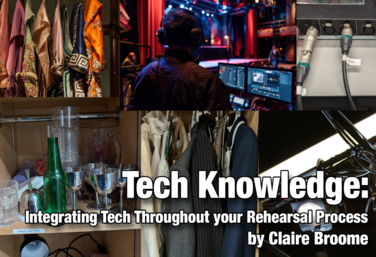
Tech Knowledge: Integrating Tech Throughout Your Rehearsal Process
by Claire Broome
17 modules
1 hours, 52 minutes
3 Credit Hours
This course will help you integrate technical theatre earlier in the creative process to help reduce the stress of tech week, and make sure you have what you need before choosing a show. We will explore how to include your technical theatre team from day one and will help you have an easier experience throughout the rehearsal process and final performances.
View all Standards for Texas Essential Knowledge and Skills for Theatre Arts Standards Master List