Virginia Standards Of Learning (2020)
Theatre Arts I: Introduction to Theatre
39 units • 8 professional development courses aligned to TI.14 - The student will demonstrate theatrical direction, including blocking and staging a scene.
TI.14 The student will demonstrate theatrical direction, including blocking and staging a scene.
This page lists 39 units and 8 professional development courses aligned to TI.14 from the Virginia Standards Of Learning (2020). Designed for drama teachers, these resources directly address TI.14 - The student will demonstrate theatrical direction, including blocking and staging a scene.
While the Drama Two Curriculum has a focus on acting, it’s always important to include a unit on the technical theatre skills that are necessary to any production. Students will also be able to use what they’ve learned in this unit in their upcoming devising project.
Students will begin by exploring design for the stage by experimenting with line, shape, texture, size, and color. They will expand their understanding of stage properties and scenic flats. They will then apply their knowledge of these building blocks of design to create a high-concept design for a miniature “stage.”
Improv is a fantastic method to engage your students; this 3 lesson mini unit is a great way to introduce improvisation.
This unit focuses on learning the rules of Improv, trying games to build improvisation skills, and developing conflict and story line.Through the three lesson series, students will use journals, participate in class discussions, learn six different improv games, and perform for their peers.
Assessment tools include both informal assessment as well as a formal quiz that’s included in the unit.
In studying Ancient Greece, we’re looking at the foundations of theatre as we know it today. Without the Ancient Greek Era, we do not get actors, theatres, plays, and the definitions of tragedy and comedy.
The issue with studying theatre history, or anything historical is that it can become an exercise in memorizing dates and reciting facts. When the truth of the matter is no one in the 21st century benefits from learning by rote. This is especially true when studying history in the framework of a drama classroom. We need exercises that bring history to life, instead of having students plot dates on a timeline.
To that end, this unit does not focus on dates and data. The essential question for the unit is how can we connect the past to the present and this question is explored through the theatricalization of information. Students will access all four 21st century skills, critical thinking, creative thinking, collaboration and communication as they explore this amazing world.
Reflections, exit slips, and rubrics are included throughout the unit as well as a mid assignment evaluation for the culminating project.
Teacher Angel Borths developed this unit when she was looking for lessons to teach the basics of pantomime in the classroom.
This unit culminates in a finished product for performance, either for peers, or for theatre festivals. The rubrics and written work for this unit take planning and preparation for performance into account. The exercises can be pulled out and used independently, but work best when used to build toward a finished product. You can also pull the ground plan and stage directions lesson plans to use with playwriting or directing lessons.
Students will get “onstage.” They will explore what is important for onstage action, the basics of stage directions, and how to keep open. This unit will culminate with students trying out what they’ve learned in a short scene.
This unit is more about the technicalities of moving on stage. By giving students something concrete to focus on, it allows them to overcome any stage fright.
Ensemble-building exercises are also included in this unit. If you have time at the end of a lesson after you’ve completed your instruction and are wondering what to do, you can never go wrong with an ensemble-building exercise!
In this unit, students will explore nonverbal communication: first, through body language and gesture, and then through the specific art of pantomime. Students will learn hand position, tension, follow-through, and action/reaction/interaction with objects through warm-up games and exercises. The unit culminates in a two-person pantomime performance.
This unit on Ancient Greek theatre focuses on the function of the chorus, the choral ode, and the details of the theatre space. It touches on plays and playwrights of the era, culminating in a final project of a modern version of Medea that includes a choral ode.
Students sharpen their listening and reaction skills through improv games, exercises, and scenes. They will learn five specific guidelines to apply to their improvisation: accept the offer, bring information to the scene, make active choices, make your partner look good, and don’t force the humour.
There are so many different ways to approach a unit on improvisation. Keep in mind that you will have students who are really excited about this unit and some students who dread it. It’s best to start with low-risk games and exercises and then build up to higher-risk ones. Low-risk games in this situation mean partnered interactions that aren’t shared with the whole class.
Students will discover, analyze, and explore the history, characters, and style of commedia dell’arte.
Commedia dell’arte is a theatre history unit mixed with improvisation, physicalization, and exploring specific characters. In this unit, we’re going to focus on three main aspects:
1. Causes and Effects of Commedia (History)
2. Stock Characters
3. Commedia Performance Practices
Students will explore the structural elements of a play: character, objective, obstacles, tactics, resolution, and raising the stakes. They will also learn how to write character-driven dialogue and stage directions. Students will work in groups to create and present a short play.
This unit will enable students to identify, compare, and contrast three different styles of Japanese theatre: Noh, Bunraku, and Kabuki. There are three proposed projects in this unit: a research assignment where groups delve into further detail about one of the three styles; a performance project where students utilize what they’ve learned by enacting a scene from a Kyogen (comedic) play; and a Bunraku puppet play.
The final project will incorporate multiple areas that students have studied over the course of the year/semester: playwriting, acting, scenic design, and marketing. They are putting everything they’ve learned into a final package, including writing, rehearsing, and performing.
Join Matt Banaszynski in this dynamic unit designed to introduce students to the process of starting, drafting, polishing, and performing a self-created, stand-alone monologue.
This unit introduces students to writing their own stand-alone monologues. Students will learn the steps involved in going from a simple idea to a written piece to performing that piece. They will also provide feedback to others and give themselves a self-assessment.
This unit has been prepared for a middle school drama class but could be adapted for high school. It was designed as a way to get non-theatre students more involved in theatre.
This unit on Puppetry is designed for middle school and up, to introduce students to the material and get them comfortable with performing in a safe and low exposure environment.
This is a unit that builds to a culminating experience for your students. Each lesson is designed to explore techniques, provide opportunities for creative collaboration among your students, and give them opportunities to perform. Some of the lessons require materials to build or create puppets. Puppetry can be as easy as drawing a face on your finger for finger puppets, to actually purchasing your own finger puppets for students to use.
While the focus of this unit is puppetry, your students will explore other skills as well. There’s the obvious ones of creative thinking, teamwork, and problem solving. They are also going to explore storytelling, performing skills, and playwriting.
Help… It’s all Greek to me! Join Angel Borths in this unit that uses a modern adaptation of the Ancient Greek play Antigone to introduce Middle School students to Ancient Greek Theatre.
Have your students read Percy Jackson and want to find out more about Ancient Greece? Then, this unit is for you. This unit is designed for middle and high school students and will take you through the basics of classical Greek theatre and pairs it with a modern adaptation of the story of Antigone called Agatha Rex by Lindsay Price. Students will learn vocabulary, design, and basic theory surrounding classical Greek theatre. Students will also enjoy the mask-building component of this unit, as they learn to disappear into the character of a mask, like the first actors did on a Greek stage thousands of years ago.
The unit culminates in a scene performance with masks.
In this unit, students explore how to communicate with their body by exploring elements of physicality and Pantomime. Lesson one helps students explore body awareness as well as the use of the senses and details in pantomime performance. In lesson two, students explore body language and how it is used to communicate by examining the art of flirting. Lesson three helps students create a distinct physical characterization. Lesson four introduces students to the quality of Pantomime – Consistency. In lesson five, students explore the quality of exaggeration in pantomime. In the final lesson, students prepare a pantomime story for performance.
Through this six lesson series, students will use journals, participate in class discussions and practice the elements taught by performing for their peers and as a class. Assessment tools include both informal assessment as well as a final Pantomime performance.
In Part 2 of the Monologue Unit (Monologue Project: Analysis, Writing, and Performance), students analyze an existing monologue to determine the criteria for a “good” monologue. They will then apply what they learned in Part 1 (Monologue Writing Made Easy), adding in the criteria for a “good” monologue, to write and perform an original monologue.
Students are introduced to scene work performance through a simple, contentless scene unit. In this unit, performers will use exercises like “Show and Tell” to learn how to fill in the gaps of a story by creating scenarios and detailed characters with backgrounds.
Students will further fill in the gaps by exploring environmental and physical conflict as well as stage business. The lesson “Thou Shalts of Staging” will guide students through basic staging and performance technique.
Commedia dell’arte is a 16th century masked acting form. It is the basis of all comedy, including all tv sitcoms. This form is characterized by masked types and archetypical characters and a specific way of playing comedy. To that end, this unit is divided into two parts.
Part One focuses on the foundations of commedia - playing comedy. These principles will be important to learn when it comes to developing commedia characters, specifically the physicality of the characters. Part Two will cover lazzi.
Note: there are links to video demos in many of the lessons of this unit.
The purpose of this unit is to give students an introduction to independent learning as well as an overview of Ancient Greek theatre. Students will apply their knowledge throughout, and the unit culminates in a group activity.
This unit is delivered in hyperdoc format. What does that mean? A hyperdoc is an interactive tool that encourages digital learning. In this case, students are given a document on a subject, and there they can read articles, watch videos, do some independent research, and apply what they’ve learned. Because they’re working on their own, students are in charge of their own pacing.
Before you start the unit, ensure you read the Teacher Guide first. It will give you clear instructions on how to distribute the hyperdoc format and make it easy for you and your students.
The objective of this unit by John Minigan is to move students from a traditional presentational model of performance to a three-dimensional model. You’re going to achieve this by having students
- Develop tactics to achieve character goals, despite obstacles
- Connect physical choices to scene structure and relationships
- Clarify tactics and story rather than forcing emotion
- And focus on the scene partner rather than the self
This unit was created to use with grade nine students as a transition from middle school to high school acting approaches. It would also be appropriate for a beginning-of-the-year unit for a program that includes Drama 1. But any class that is at the beginning of their acting process will find value.
Each lesson comes with an engagement Rubric to assess how students participated in the activities and discussions.
Students will be introduced to the most basic of scripts: the contentless/open scene script. They will use their knowledge of character/relationships, setting, objective, and tactics to add content to a contentless scene. Students will also learn the basics of set design and blocking, and will begin using voice expression to communicate clearer characters. The unit culminates in a performance assessment in which students will work in pairs to add content to and perform a contentless scene.
Want a fun project that has your students collaborating and creating? In this unit by Annie Dragoo, students in groups will write and perform an original musical by adding modern songs to a traditional fairy tale story.
The six lessons take students from writing their script, to choreography and planned movement, to rehearsing, performing and evaluation.
The Rubric will focus on student performance. That means vocal delivery, emotional delivery, blocking/choreography, energy, focus, and characters.
Instructor Laramie Dean uses this unit as the final project for his Drama 2 students. Drawing upon any of the skills students have developed throughout, they create a product that could be used within a new piece of musical theatre.
Students start by analyzing three musicals, study guides included, and practice creating musical elements. They are then given class time to prepare in groups as many elements as they can for a new musical using devised theatre techniques.
There are 24 lessons in this unit which culminates in a final assessed performance.
This is a read, discuss, and apply literature unit. Students will study the play Our Town by Thornton Wilder.
Our Town is often referred to as “nostalgic.” It’s seen as an antiquated look at a moment in time. But this play is called Our Town, not My Town. What’s happening in Grover’s Corners happened in the past, the distant past, in our present, and even in the future. The themes of the play—the ordinary versus universality, the concept of time, the cycle of life, the ignorance of humanity to the eternal—these are just as relevant in the twenty-first century as they were when the play was written.
The purpose of the unit is not to have students recall knowledge about the play. Students will be able to identify, articulate, and dramatize text themes and concepts and compare/contrast these concepts to their own experiences.
Students sharpen their listening and reaction skills through improv games, exercises, and scenes. They will learn five specific guidelines to apply to their improvisation: accept the offer, bring information to the scene, make active choices, make your partner look good, and don’t force the humor.
In this unit, students will explore nonverbal communication. First through body language and gesture, and then through the specific art of pantomime. Students will learn hand position, tension, follow-through, and action/reaction/interaction with objects through warm-up games and exercises. The unit culminates in a one-person pantomime performance.
Students are introduced to scene work performance through a contentless scene unit. Students prepare and perform a contentless scene to demonstrate their understanding of characterization, staging technique, and working with conflict and stage business in a performance context.
In Part 2 of Scene Work, students take everything they learned in Part 1 and apply it to the staging of a scene.
Students work independently to block, build character, experiment and rehearse a scene. You can continue the scene work process from Part 1, or if your students have a grounding with scene work basics, perhaps they just do Part 2 of this unit.
Taking risks, learning to see failure as a gift, finding courage when we don't feel it, and having the awareness that what we say has an impact are social and emotional skills students will take beyond the classroom. These are skills that can be built through improv exercises.
The exercises in this unit are designed to create a safe environment in which students can go beyond their old patterns to take risks, embrace failure, and be more confident and aware of the effects of their word choices. Improv gives you the opportunity to draw attention to these important concepts and to talk about them.
Students will demonstrate an understanding of the foundations of acting. At the end of the unit, students will be able to understand the value of making rich acting choices on stage.
This unit gives students an opportunity to explore and develop acting skills on a more advanced level, regardless of experience. They will explore skills, including voice, movement, emotional recall, memory, playing objectives, and character development culminating in a final scene.
The Dilemma Project is based on a situation that requires a decision: push a button and get a great reward, but there’s also a great consequence. Don’t push the button and there’s no reward.
This unit will lead to a group performance including characters, costumes, set, acting theory, acting tools, and a student written script. The final script will be about ten pages in length which means roughly ten minutes of stage time.
The unit has been adapted for a virtual environment.
This is an in-depth unit with instruction and activities about the Stanislavski acting method. It is followed by scene work in which students learn how to score a scene, do a comprehensive character analysis, and use what they have learned in rehearsals in a performance. Students will also watch their own work and evaluate their process after the performance.
The purpose of this unit is to give students an introduction and understanding of Stanislavski’s method and to put it into use as they prepare scenes for performance. After seeing their work, and spending time reflecting on how they used the principles of the method, students should take away a concrete understanding of how to prepare a role for performance.
All students have something to say and a story to tell. They can relate to their personal stories better than anyone else. All students have a lot of material which can be used as part of an original monologue.
In this unit, students will write an autobiographical monologue based on their personal expertise, memories, distinct point of view, sense of truth, and life experiences.
Through the process, students will be encouraged to explore past stories, objects, and images and other personal material.
A monologue unit is an excellent way for students to demonstrate learned skills: vocal skills, movement skills, memorization skills, and character development. It also touches on soft skills such as communication, confidence, and attitude. That being said, monologues are not easy. A typical monologue is two minutes long. That is a lot of text to memorize, block, and develop into an engaging presentation. How often have you sat through a bad monologue performance with little to no characterization, wandering blocking, and a tenuous grasp of the lines?
Performing a monologue is a learned skill. And the best way to learn a skill is in steps. Instead of starting with the end goal—that two-minute piece—start at the beginning. This four-lesson unit will take students up the ladder toward the goal of a longer monologue.
The goal for this unit is to give students a process to work primarily on their own to create a staged scene with specific, dynamic blocking and three-dimensional characters. This unit would work well as a culminating project for a semester. In this unit, students will work independently to analyze, block, build character, experiment, and rehearse a scene. Their performance can count as a summative assessment for the class.
Material: This unit requires that students have access to scenes from plays. Ideally, students should work in pairs and prepare duet scenes.
This is a research, read, discuss, and apply theatrical literature unit. Students will study the play The Crucible by Arthur Miller.
The Crucible is Miller’s most produced play. There are hundreds of high school productions each year, and the play is in many high school curricula. As with every Miller work, there is much to discuss and many rich themes to explore.
The unit is divided into three sections. Each section is a complete set of lessons. You can choose to do all three sections, or if you have your own way to teach the play, you can pick and choose exercises.
In this unit, students will combine knowledge of the previous two units: singing and movement. Students will review singing technique and terminology and work on a song together. They will build on their vocabulary of simple dance moves. Then, students will work in groups to learn and rehearse a section of a musical theatre song by choreographing movement that expresses the song’s meaning and characters, presenting their work to the class, and working on curriculum goals of risk taking, endurance, confidence, commitment, character, and emotion.
Students will show what they have learned throughout the curriculum by writing and performing a musical. They will add modern songs to a traditional fairy tale story. In this way, students do not have to create their story from scratch—the structure and characters are already in place.
Directing youth theatre can be one of the most thrilling, rewarding, and exhausting jobs there is – because it’s not just about staging a play. It’s about creating an environment that fosters hard work, dedication, trust, and the willingness to take chances, to “play without fear.”
As a writer/teacher/director of youth theatre for over 15 years, I have developed tools and strategies that enable my students and me to focus on the process of creating theatre while fostering an environment that leads to creative freedom and a cohesive groups that doesn't act as individual “stars,” but as a community of one.
In this course, I will share with you these tips and strategies, along with the ways to implement them in your theatre environment.
Working in educational theatre I know how easy it is to get bogged down in actor coaching and away from the bigger picture storytelling when directing a show. I saw a need for a method of text analysis and physical staging tools that help the director stay focused on the bigger picture of telling the story of the play.
This class is in two parts: The first consists of the text analysis tools P.A.S.T.O and Major Dramatic Question. From these tools you will brainstorm keywords to define your vision of the story.
In the second part of the class you will focus on taking the information generated in the text analysis and crafting the ideas into vibrant physical pictures through an exercise called Starburst.
In "Working With Monologues For Rehearsal And Development" you will develop ten sessions of study on monologues. The study contains the definition and history of the monologue; monologue vocabulary; analysis of a practice monologue, staging a short monologue; working with musical theatre lyrics as a monologue; writing short autobiographical monologues.
At the end of this course, you will have a curriculum which can be used as introduction to monologue work.
Gai Jones will help you establish an ensemble-based environment from the first day of class or rehearsal.
Learn how to set up your ensemble-based classroom from day one, get students to set classroom norms, and find the balance between creative activity and structure. You’ll learn how to give your students creative freedom through structure and classroom management. The cornerstone of this course are the detailed ensemble experiences from large group to small group and even individual experiences.
This course culminates in a devising model that you can use with your students, and takes you through process, product, performance and an evaluation.
You too can create the ensemble-based classroom.
Allison Williams leads the course: 21st Century Skills Through Devising. This course covers what devising is, why to do it, how to do it, and how your students can master the 21st Century Skills of collaborations and cooperation, critical thinking, creative thinking through devising.
High school is a great place to try devising with your students. But it’s not something you want to throw at your students without any preparation. Framework is important and this course takes you through a number of exercises you can take into the classroom tomorrow to help build a place of physical safety, a place where students work at making a lot of choices instead of waiting for the perfect choice, and a place where students feel comfortable making creative choices. The material also reviews the process of putting together a show from the idea/research stage to editing, to giving feedback.
Your students have what it takes to create their own material, collaborate with each other, and have a unique theatrical experience!
The focus of the teacher-director should be not only on the quality of the show, but on the value of the experience offered to student actors. This course takes you on this journey through practical rehearsal strategies that apply an ensemble approach.
This course starts with those all important first rehearsals, explores warm ups, and looks at character development. We examine specific types of plays, like classical texts and comedy, and conclude with strategies to solve common rehearsal problems.
Go beyond the basics!
Moral dilemmas are not only faced by characters in gripping plays, but are also faced by our students. The project outlined in this course will help students develop their critical thinking skills through the use of one of the dilemma questions to shape a student written production.
If you had the choice to press a button and earn $25,000,000... but a species (not of your choosing) would become extinct, what would you do? More importantly, what would your character do?
Join drama teacher and playwright Claire Broome through this course which includes role-playing, Stanislavski’s Magic If, character creation, playwriting and staging.
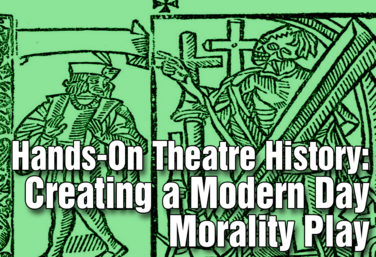
Who says theatre history has to be boring? Hands-On Theatre History: Creating a Modern Day Morality play is an interactive course by Wendy-Marie Martin, combining hands-on activities with research and analysis techniques leading to a full performance of the popular medieval morality play, Everyman.
This course gives students an overview of the medieval period and the various medieval play forms and teaches students the key points of storytelling and adaptation.
It includes dynamic individual and group exercises leading students from the first steps of the adaptation process through a final, full-class performance of Everyman—and proves, once and for all, that theatre history can be fun and exciting to learn.
Our parent company Theatrefolk offers a fantastic selection of plays written specifically for high school and middle school students.
Whether for performances or class study, there's something for everyone: relevant & relatable themes, simple sets & costumes, flexible casting options and much more - a perfect addition to any drama program!
Please note:
Plays are offered separately from your membership and can be purchased through Theatrefolk.