Texas Essential Knowledge and Skills for Theatre Arts
HS 117.317 LIII - Creative Expression: performance
34 units • 13 professional development courses aligned to C.2.A - employ safe, appropriate techniques to allow for physical, vocal, and emotional expression.
C.2.A employ safe, appropriate techniques to allow for physical, vocal, and emotional expression.
This page lists 34 units and 13 professional development courses aligned to C.2.A from the Texas Essential Knowledge and Skills for Theatre Arts. Designed for drama teachers, these resources directly address C.2.A - employ safe, appropriate techniques to allow for physical, vocal, and emotional expression.
While the Drama Two Curriculum has a focus on acting, it’s always important to include a unit on the technical theatre skills that are necessary to any production. Students will also be able to use what they’ve learned in this unit in their upcoming devising project.
Students will begin by exploring design for the stage by experimenting with line, shape, texture, size, and color. They will expand their understanding of stage properties and scenic flats. They will then apply their knowledge of these building blocks of design to create a high-concept design for a miniature “stage.”
Improv is a fantastic method to engage your students; this 3 lesson mini unit is a great way to introduce improvisation.
This unit focuses on learning the rules of Improv, trying games to build improvisation skills, and developing conflict and story line.Through the three lesson series, students will use journals, participate in class discussions, learn six different improv games, and perform for their peers.
Assessment tools include both informal assessment as well as a formal quiz that’s included in the unit.
In this unit, students will explore nonverbal communication: first, through body language and gesture, and then through the specific art of pantomime. Students will learn hand position, tension, follow-through, and action/reaction/interaction with objects through warm-up games and exercises. The unit culminates in a two-person pantomime performance.
This unit focuses specifically on the technical aspects of vocal production. By understanding how voice is created, students will be more aware of how to improve their vocal production. Students will explore posture and breathing exercises, as well as how to use the diaphragm, projection, and articulation. The final project will test students’ ability to properly project and articulate a joke across a large space.
This unit on Ancient Greek theatre focuses on the function of the chorus, the choral ode, and the details of the theatre space. It touches on plays and playwrights of the era, culminating in a final project of a modern version of Medea that includes a choral ode.
Students sharpen their listening and reaction skills through improv games, exercises, and scenes. They will learn five specific guidelines to apply to their improvisation: accept the offer, bring information to the scene, make active choices, make your partner look good, and don’t force the humour.
There are so many different ways to approach a unit on improvisation. Keep in mind that you will have students who are really excited about this unit and some students who dread it. It’s best to start with low-risk games and exercises and then build up to higher-risk ones. Low-risk games in this situation mean partnered interactions that aren’t shared with the whole class.
Students will discover, analyze, and explore the history, characters, and style of commedia dell’arte.
Commedia dell’arte is a theatre history unit mixed with improvisation, physicalization, and exploring specific characters. In this unit, we’re going to focus on three main aspects:
1. Causes and Effects of Commedia (History)
2. Stock Characters
3. Commedia Performance Practices
This unit will enable students to identify, compare, and contrast three different styles of Japanese theatre: Noh, Bunraku, and Kabuki. There are three proposed projects in this unit: a research assignment where groups delve into further detail about one of the three styles; a performance project where students utilize what they’ve learned by enacting a scene from a Kyogen (comedic) play; and a Bunraku puppet play.
Musical Theatre has two components that separate it from straight plays: song and dance. This unit gives students the opportunity to try out both. In musical theatre, music signifies heightened emotion. We can’t express ourselves with just words, we need music (and through extension, song and dance) to take it further.
This unit includes three lesson plans:
1. Acting the Song - “Musical Tactics”
2. Acting the Song - “Textual Analysis”
3. Introduction to Dance
A solo performance assignment is also included, and the unit includes assessment tools - rubrics, reflections, and self-evaluations.
In this Mock Audition Unit, students will start by discussing the audition process. They will make connections between their personal views and the process. Students will then apply the steps of auditioning from putting together a resume, to choosing a piece based on provided information, to audition etiquette, to the actual audition itself. A final reflection and rubric are provided for use at the end of this unit.
A short play is included that can be used as the source material. You can also choose your own play for this process.
In this unit, students will be introduced to a key element of performance: the voice. Students will explore how to thoughtfully communicate character, story, and emotion vocally. Students will begin by exploring articulation so that they understand the importance of clearly communicating their words onstage. They will further build on this with the following lesson on the different vocal varieties of pitch, tone, rate, and volume.
The final lesson helps students explore vocal characterization as well as the details and layers that can bring that character to life vocally. This unit study of the voice culminates in a final puppet show where students are asked to bring a story and character to life by using vocal variety, articulation, and characterization.
Help… It’s all Greek to me! Join Angel Borths in this unit that uses a modern adaptation of the Ancient Greek play Antigone to introduce Middle School students to Ancient Greek Theatre.
Have your students read Percy Jackson and want to find out more about Ancient Greece? Then, this unit is for you. This unit is designed for middle and high school students and will take you through the basics of classical Greek theatre and pairs it with a modern adaptation of the story of Antigone called Agatha Rex by Lindsay Price. Students will learn vocabulary, design, and basic theory surrounding classical Greek theatre. Students will also enjoy the mask-building component of this unit, as they learn to disappear into the character of a mask, like the first actors did on a Greek stage thousands of years ago.
The unit culminates in a scene performance with masks.
In this unit by Anna Porter, students are introduced to the works of Shakespeare and explore how to bring a character to life in a monologue performance. Students are also introduced to the tools to help them unlock meaning in Shakespeare’s text. Through this eleven lesson series, students will participate in class discussions, activities and performance. Assessment tools include informal assessment, submission of textual analysis work and a final performance.
Shakespeare’s text holds valuable tools that students can use to unlock and understand meaning. In this unit by Anna Porter, students explore how to use the tools of research, context, textual analysis, imagery and punctuation to help them unlock meaning in Shakespeare’s text. This unit is created for an Intermediate to Advanced drama class with a basic background in plot structure and acting technique.
Through this five lesson series, students will use journals, participate in class discussions, activities and performance to explore the tools used to unlock a text. Assessment tools include informal assessment as well as a final group presentation and performance.
Commedia dell’arte is a 16th century masked acting form. It is the basis of all comedy, including all tv sitcoms. This form is characterized by masked types and archetypical characters and a specific way of playing comedy. To that end, this unit is divided into two parts.
Part One focuses on the foundations of commedia - playing comedy. These principles will be important to learn when it comes to developing commedia characters, specifically the physicality of the characters. Part Two will cover lazzi.
Note: there are links to video demos in many of the lessons of this unit.
In this unit, students will learn, practice and apply three important rules of improv: accepting and building on offers, quick thinking, and strong offers. For each step, they will work with the Improvisation Rubric by both giving and receiving feedback. Students will also start to practice techniques to improve their vocal clarity. The unit culminates in a performance assessment in which students will play an improv game in front of an audience.
Students will understand the basic building blocks of a scene: The Who (characters/ relationship), the Where (setting), and the What (conflict – objectives/tactics). They will learn how to use both verbal and nonverbal (pantomime) clues to communicate these scene details to an audience. They will continue to work on voice clarity, while also learning to open their body to an audience. The unit culminates in a performance assessment in which students work in pairs to improvise a scene.
Students will now start applying the skills they’ve learned thus far in the context of existing, fleshed-out scripts.
They will also have opportunities to shift from actor to director and hone such skills as collaboration, self-confidence, and problem-solving which can be used in many other areas of their lives.
Students will have another opportunity to participate in student-directed scenes, only this time each director will be assigned a different script, and actors for each group will be chosen by the teacher based on individual strengths and challenges, rather than holding auditions.
Actors will take a deeper dive into character physicality and use of levels in staging this unit. Directors will continue to create a set design and block the scenes, adding props as well in this unit.
The unit culminates in actors presenting their directed scenes to the class.
Students will have a chance to merge their understanding of scene elements with their improvisation skills in this final unit based on Augusto Boal’s Theatre of the Oppressed. Theatre of the Oppressed is a style of theatre specifically created to highlight the injustices of power and oppression in society and to problem-solve ways to bring about change.
Starting with image theatre techniques to identify issues of power and oppression, students will then use forum theatre to create scenarios of oppression taken from their own lives and improvise realistic solutions.
The unit culminates in a performance in which students participate as both actors in a scene they create themselves and spect-actors in scenes created by their peers.
Students sharpen their listening and reaction skills through improv games, exercises, and scenes. They will learn five specific guidelines to apply to their improvisation: accept the offer, bring information to the scene, make active choices, make your partner look good, and don’t force the humor.
In this unit, students will explore nonverbal communication. First through body language and gesture, and then through the specific art of pantomime. Students will learn hand position, tension, follow-through, and action/reaction/interaction with objects through warm-up games and exercises. The unit culminates in a one-person pantomime performance.
This unit focuses specifically on the technical aspects of vocal production. By understanding how voice is created, students will be more aware of how to improve their vocal production. Students will explore posture and breathing exercises, as well as how to use the diaphragm, projection, and articulation. The final project will test students’ abilities to properly project and articulate a joke at a distance from a microphone
In this Mock Audition Unit, students will discuss the audition process and make connections between their personal views and the process. Students will apply the steps of auditioning from putting together a resume to choosing a piece based on provided information to audition etiquette to the actual audition itself.
A final reflection and rubrics are provided for use at the end of this unit.
A short play is included that can be used as the source material for your audition. You can also choose your own play for this process.
Taking risks, learning to see failure as a gift, finding courage when we don't feel it, and having the awareness that what we say has an impact are social and emotional skills students will take beyond the classroom. These are skills that can be built through improv exercises.
The exercises in this unit are designed to create a safe environment in which students can go beyond their old patterns to take risks, embrace failure, and be more confident and aware of the effects of their word choices. Improv gives you the opportunity to draw attention to these important concepts and to talk about them.
Students will demonstrate an understanding of the foundations of acting. At the end of the unit, students will be able to understand the value of making rich acting choices on stage.
This unit gives students an opportunity to explore and develop acting skills on a more advanced level, regardless of experience. They will explore skills, including voice, movement, emotional recall, memory, playing objectives, and character development culminating in a final scene.
In this unit, students will create and perform an abstract theatre scene. Abstract is a genre that does not rely on realism and deliberately breaks the rules of a given form. In the case of theatre, this refers to the commonly presented rules of performance, acting, and the relationship with the audience. Movement is often stylized and symbolic. Ideas and themes are expressed visually and aurally with little dialogue using music, lights, costumes, and props.
This is an in-depth unit with instruction and activities about the Stanislavski acting method. It is followed by scene work in which students learn how to score a scene, do a comprehensive character analysis, and use what they have learned in rehearsals in a performance. Students will also watch their own work and evaluate their process after the performance.
The purpose of this unit is to give students an introduction and understanding of Stanislavski’s method and to put it into use as they prepare scenes for performance. After seeing their work, and spending time reflecting on how they used the principles of the method, students should take away a concrete understanding of how to prepare a role for performance.
The unit has been adapted for a virtual environment.
This is an in-depth unit with instruction and activities about the Stanislavski acting method. It is followed by scene work in which students learn how to score a scene, do a comprehensive character analysis, and use what they have learned in rehearsals in a performance. Students will also watch their own work and evaluate their process after the performance.
The purpose of this unit is to give students an introduction and understanding of Stanislavski’s method and to put it into use as they prepare scenes for performance. After seeing their work, and spending time reflecting on how they used the principles of the method, students should take away a concrete understanding of how to prepare a role for performance.
All students have something to say and a story to tell. They can relate to their personal stories better than anyone else. All students have a lot of material which can be used as part of an original monologue.
In this unit, students will write an autobiographical monologue based on their personal expertise, memories, distinct point of view, sense of truth, and life experiences.
Through the process, students will be encouraged to explore past stories, objects, and images and other personal material.
In this unit, students will create a performance of a spoken word poem designed to engage, entertain, and affect an audience. They will also write a poet’s statement in which they describe the purpose(s) or inspiration(s) of their poetry.
This is not a technical writing unit and is geared more toward students self-expression and engaging an audience. If your students are not skilled poets, this unit is still accessible.
Shakespeare is sometimes avoided in the drama classroom because not only do the students not want to take on the language difficulties but neither do the teachers. Monologue and scenework becomes more challenging and a lot of times, students falter in their blocking action and character development because they are so challenged. How do we give students the opportunity to rehearse and present Shakespearean text as they would modern text?
In this play study unit, students will read a Shakespeare play while learning specific tools and techniques in order to stage text from that play. And more often than not, these techniques are ones that they have already used with other plays. It’s all about reframing Shakespeare so that students enjoy the experience of bringing the characters and stories to life.
This is an advanced acting unit in playing character through the Laban movement technique. Students will explore dance theorist Rudolf Laban’s eight efforts and their component parts; turn these elements into physicalizations through which one can express character; use Laban efforts and connect them to a character’s voice and body; and demonstrate knowledge through the creation of an original character.
Reminder: This is an advanced acting unit. You will need students who can do work on their own outside of class time, commit to movement and sound, and commit to making instinctual choices.
In this unit, students will be introduced to the musical theatre form by asking and answering the question “What is a musical?” They will learn and demonstrate knowledge of musical theatre vocabulary terms. They will be introduced to two foundational songs in the musical form: the “I want” song and the “I am” song and analyze an example of each song. They will also start to think about their own voices and reflect on their skill set and confidence level with regard to singing in front of others. Students will learn the musical theatre warm-up that will be used throughout the curriculum. This set of exercises will help students prepare to perform through a physical and voice warm-up. Finally, students will watch, discuss and analyze one or two musicals (depending on your time and access to materials).
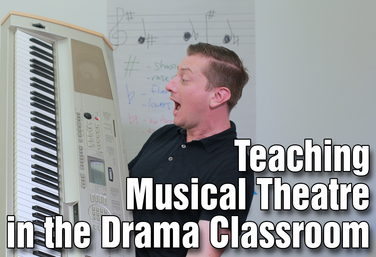
Colin Oliver leads this introduction to teaching Musical Theatre in the Drama Classroom.
In this course, you will learn how to build musical theatre into your dramatic courses of study. “Why might you want to do that? Singing is scary! You want me to teach my students how to do it? I don’t even know how to do it.” This course approaches musical theatre preparation performance much as we would approach preparing a monologue in drama. If you use script analysis in monologue preparation in your class, you can teach musical theatre.
By the end of this course, you’ll have a great, full-body physical warm-up, a student-driven research assignment, character development exercises, a little bit of musical theory, and a performance assignment complete with assessment.
So, join us for teaching Musical Theatre in the Drama Classroom. It’s as easy as Do-Re-Mi!
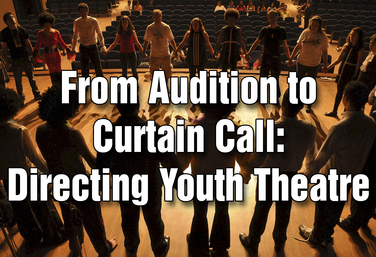
Directing youth theatre can be one of the most thrilling, rewarding, and exhausting jobs there is – because it’s not just about staging a play. It’s about creating an environment that fosters hard work, dedication, trust, and the willingness to take chances, to “play without fear.”
As a writer/teacher/director of youth theatre for over 15 years, I have developed tools and strategies that enable my students and me to focus on the process of creating theatre while fostering an environment that leads to creative freedom and a cohesive groups that doesn't act as individual “stars,” but as a community of one.
In this course, I will share with you these tips and strategies, along with the ways to implement them in your theatre environment.
Friendly Shakespeare teaches a simple and effective method of script analysis for Shakespeare. It uses punctuation and keywords in the text to help students understand the characters' needs, make specific acting choices, and get them on their feet immediately.
This is not dry, sitting in a classroom discussion. It’s physicalizing the text, focusing on the character’s needs and tactics (something every drama student should know full well) and bringing Shakespeare to life.
At the end of the class you will be able to demystify Shakespeare's text and understand how to help your actors make clear, active and emotionally connected choices in Shakespeare's plays.
This mini-course will give you a toolkit to bring your shows to the next level by having an engaged, active, ensemble.
The ensemble is a critical part of a large cast show. But you can't leave them to fend for themselves. They need structure. They need exercises and activities.
In Strong Ensemble = Strong Play, you'll be given ensemble-building exercises. You'll also discover specific activities that will help your ensemble become three-dimensional characters who have something to do and something to play in every moment they are on stage.
We'll look at case studies that take the exercises learned in the course and apply them to specific shows.
In "Working With Monologues For Rehearsal And Development" you will develop ten sessions of study on monologues. The study contains the definition and history of the monologue; monologue vocabulary; analysis of a practice monologue, staging a short monologue; working with musical theatre lyrics as a monologue; writing short autobiographical monologues.
At the end of this course, you will have a curriculum which can be used as introduction to monologue work.
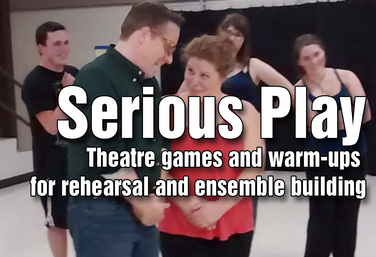
In this class, Serious Play, the instructor will lead you through a series of games in risk, movement, focus, and voice. You will get access to a series of all inclusive games that you can string together to make one giant game that is great to use in rehearsal. You will learn how and when to use these games.
You'll get ideas on how to craft your own warm-up lesson plan; and, most importantly, you'll learn about about a pre-class warm-up that you can do on your own so that you can get yourself into that third stage of the creative brain, so that you can begin trying out interesting, creative, and risky choices for yourself in your classes and in rehearsals.
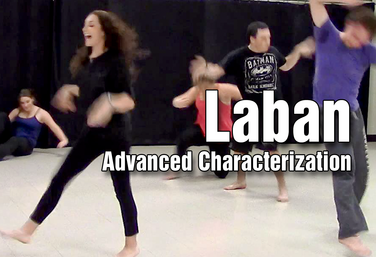
Learn about the Laban system to teach your students to physically and vocally discover character. This is an advanced course, which means that the course goes deep into exploring character and exploring character work through the work of Rudolph Laban.
In this course, you will learn what breath control and projection are, how to breathe from your diaphragm and speak loudly without yelling, and how to teach these skills to your students. Led by teacher and singer Elisabeth Oppelt, this course will be helpful both in your teaching practices and in creating material to teach your students. This course also includes both formal and informal assessments for you to use in your classroom.
Commedia dell’arte is a 16th Century masked acting form. It’s the basis of all comedy and it’s a form that many teachers want to include in their curriculum.
Instructor Todd Espeland has designed two courses that work hand-in-hand with teaching this fantastic physical form.
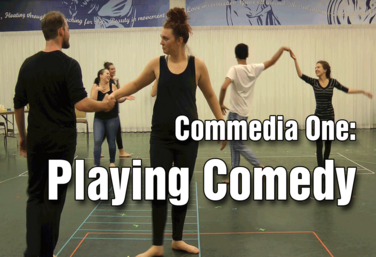
In Commedia I: Playing Comedy - Todd teaches the principles of comedy through four key elements: status, appetite, swing, and intention/invention. This course provides an excellent foundation upon which to explore Commedia to its fullest. Includes bonus videos, handouts, reflections, and exit slip question ideas for each lesson.
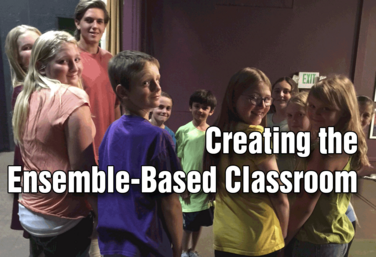
Gai Jones will help you establish an ensemble-based environment from the first day of class or rehearsal.
Learn how to set up your ensemble-based classroom from day one, get students to set classroom norms, and find the balance between creative activity and structure. You’ll learn how to give your students creative freedom through structure and classroom management. The cornerstone of this course are the detailed ensemble experiences from large group to small group and even individual experiences.
This course culminates in a devising model that you can use with your students, and takes you through process, product, performance and an evaluation.
You too can create the ensemble-based classroom.
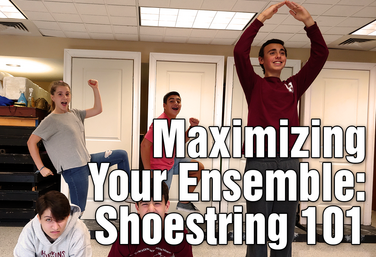
This seven-part series is designed to transform that gaggle of actors cluttering your backstage from cumbersome extras into nothing less than the very center of your production.
Instructor Michael Calderone leads this course, through games and exercises geared to maximize your ensemble for your next production. These lessons are based on the ensemble technique that he's been using for the last 30 years, called the shoestring method.
The ensemble has a responsibility to work as one, and no role is more important than another. Without each actor playing their part, the other actors cannot tell the story to the best of their abilities. So join Michael in learning more about this exciting, practical and dramatic method.
SEL stands for Social Emotional Learning. Theatre teachers know that Social Emotional Learning and its categories: Self-Awareness, Self-Management, Social Awareness, Relationship Skills and Responsible Decision Making, are innate in what we do.
The goal of this mini-course is to show you that you can take SEL in the way that your administration wants you to, using the language they want you to use, and apply it to lessons you already teach.
Instructor Christa Vogt will take you through the facets of SEL, and then take you step by step through an activity - to show you how you can apply SEL to each and every step.
The skills identified in Social Emotional Learning are the same skills theatre teachers spotlight in the warmups, games, and activities, as well as group work and theater-related assignments found in the drama curriculum every day.
This course will break down the various games and activities in the drama classroom to identify, incorporate, and intensify the Social Emotional Learning outcomes we want our students to achieve. By the end of this course, you will be able to identify the five components of Social Emotional Learning and see the places in the curriculum where they intersect with basic games and activities in the drama classroom.
Our parent company Theatrefolk offers a fantastic selection of plays written specifically for high school and middle school students.
Whether for performances or class study, there's something for everyone: relevant & relatable themes, simple sets & costumes, flexible casting options and much more - a perfect addition to any drama program!
Please note:
Plays are offered separately from your membership and can be purchased through Theatrefolk.